


🔥 EXCLUSIVE. Neural Networks in Videostreaming: From Disconnected Tools to a Media Ecosystem
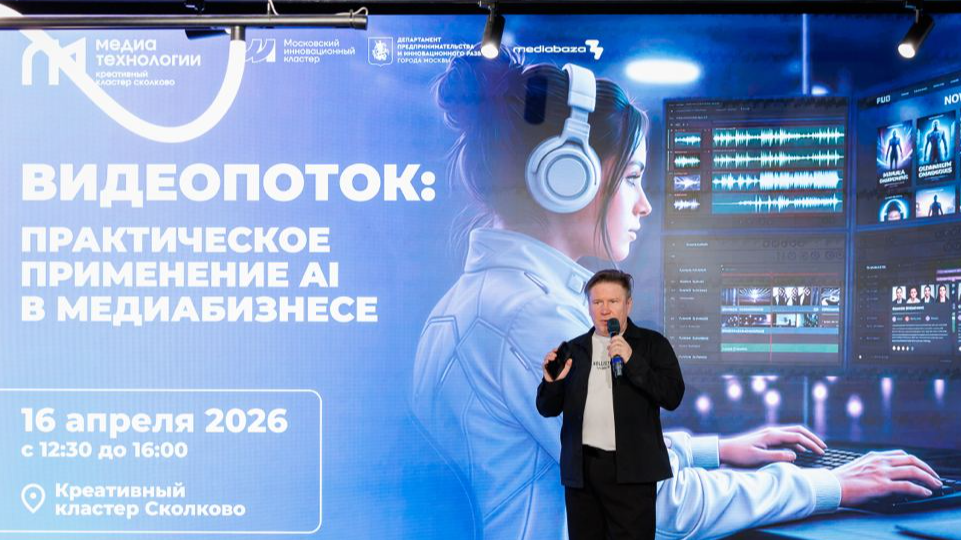
On April 16, the Skolkovo creative cluster became the epicenter for discussing the future of digital media. The business session "Videostream: Practical Application of AI in the Media Business," organized by the Moscow Innovation Cluster (MIC) in collaboration with MSK-IX’s Mediabaza platform, clearly demonstrated that the industry has moved past the initial introduction phase with neural networks.
The era of chaotic experimentation is giving way to mature solutions and deep integration. The central theme of the meeting was the transition from isolated AI projects to a unified technological ecosystem capable of meeting all the needs of modern media production. Neural networks are no longer an experiment; they have become a standard working tool used across production, distribution, and content consumption.
The Global Landscape and Creative Investment
The generative AI market in the media sphere has evolved from a niche direction into a standalone industry with massive capitalization. As Anton Vorykhalov, Development Director at Blooper.ai, noted, venture capital investment in this sector has reached $18 billion, with over 200 active startups. This is more than just a statistic; it is evidence of a tectonic shift in how content is created and processed. Today’s global AI map covers everything from basic infrastructure to complex distribution systems. However, production tools—specifically editing, video generation, and sound engineering—are becoming the primary engines of growth.
Analyzing the market structure, Vorykhalov emphasized that we are witnessing the formation of a complete production chain.
“This is a full-fledged ecosystem, ranging from infrastructure with low-margin business models to promising avenues like distribution, LegalTech, and AI avatars,” he stated.
According to him, the demand from creators for fast, convenient pre-production solutions will only continue to rise, forcing developers to create more integrated products that fit seamlessly into the existing pipelines of broadcasters and studios.
From Attention Retention to the “Digital Happiness” Economy
Recommendation systems remain one of the most mature and commercially viable applications of AI. Today, a successful streaming service or music platform is unimaginable without a smart feed. Evgeny Ilyushin, Director of AI at Okko and Academic Director at Central University, emphasized that content and delivery algorithms have become inseparable. While the industry previously focused on watch time, the focus is shifting toward user satisfaction. The industry recognizes the risks of “information bubbles” and addiction; consequently, “happiness metrics” are taking center stage to maintain long-term audience loyalty.
The technological evolution here is moving toward multimodality. Modern models can simultaneously analyze video, audio, and metadata to offer viewers content that matches their current emotional state.
“Recommendation systems now have a profound impact on business. It is a serious development that can no longer be ignored,” Ilyushin remarked.
He sees the future of the industry in “agentic systems,” where AI engages in a dialogue with the user to help them navigate the vast ocean of content, making the interaction as personal as possible.
Airtime Watch: Real-Time Monitoring
Beyond creation and recommendation, controlling content distribution is vital. In an oversaturated media landscape, reaction speed is a critical success factor. Evgeny Khilchenko, Head of SonicScout PRO, presented a global monitoring system that allows broadcasters and brands to “hear” and “see” their content in real time. Using a network of over 200 receivers, the system analyzes TV, radio, and digital streams with an accuracy rate of over 99%, automating tasks that previously required entire departments.
For media holdings, such automation is more than just a cost-saving measure—it is a way to gain instant analytics for management decisions. Delivering data within 15 minutes of airtime changes the game for advertising monitoring and competitor tracking.
“For some, AI is a problem; for others, it is a tool and an opportunity to make fast, operational decisions based on visual data,” summarized Khilchenko.
The Intellectual Shield and the Legal Field
As digital content volume grows, so do the risks to intellectual property. Media is one of the most complex areas for copyright, as a single video can contain dozens of protected assets. Anna Grashchenkova, Deputy General Director of NRIS, pointed out that modern pirates are becoming more inventive, using neural networks to alter content. However, protection technologies are advancing just as rapidly. The Anti-Pirate service utilizes Large Language Models (LLMs) for semantic analysis, identifying matches even in heavily modified materials.
Statistics show that modern automated systems find pirated copies in 99% of cases. Grashchenkova explained that the challenge is “to catch the exact moment where permitted borrowing turns into theft or piracy.” Integrating these mechanisms directly into storage and distribution platforms ensures that rights holders are protected at every stage of a work’s lifecycle.
Compliance Automation as a Necessity
Content security also involves regulatory compliance. With stricter laws and significant fines for improper labeling or prohibited content, manual verification of massive archives is physically impossible. Natalia Tylevich, CEO of Social Laboratory, addressed the issue of AI compliance. Her company’s Linza detector can verify video four times faster than real-time, automatically identifying prohibited themes.
This represents a shift toward preventive control. The neural network does not just flag a violation; it allows the broadcaster to make edits before the content reaches the regulator’s eyes.
“Regardless of whether you are a TV channel or an OTT platform, as soon as you capture a large enough audience, the law begins to monitor you very closely,” Tylevich emphasized.
Synergy through a “Single Window”
The case studies presented lead to one conclusion: the media industry requires the centralization of these powerful tools. Using fragmented services from different providers creates integration and support challenges. The market’s answer is an industrial platform that combines storage, distribution, and intelligent processing. This is the concept behind Mediabaza, which integrates content transactions, technological services, and cloud infrastructure.
Grigory Kuzin, Director of Media Platforms at MSK-IX, presented Mediabaza as the link between innovation and business. The platform is designed as an environment where a broadcaster can find content in the “Market” and immediately run it through “Techno” AI services—be it quality checks, compliance, or copyright protection.
“Mediabaza becomes the assembly point where content meets technology… and Russian media services and content gain the opportunity to move toward export,” noted Kuzin.
Toward an Industrial Standard
In conclusion, experts agreed that the future of the media business lies in deep platform integration. The time when one could succeed using just one or two AI tools is ending. Modern competition requires a comprehensive approach: content must be high-quality, creative, protected, personalized, and legally sound. Projects like Mediabaza are forming a new industrial standard, allowing companies of all sizes to focus on creativity while trusting verified algorithms with the routine.