



✅ AI content labeling does not diminish video ad effectiveness
Amid mounting pressure from international regulators and digital platforms demanding mandatory disclosure of AI usage, research firm MediaScience has published reassuring data for the advertising industry.
The study reveals that a “Generated by AI” disclosure tag on video commercials does not harm brand perception or lower key campaign performance metrics.
Analysts tested four distinct labeling formats among 900 US respondents, aligned with the standards currently under consideration by American and European lawmakers. The configurations tested included: a text overlay during the first 3 seconds of the video, a text overlay from seconds 4 to 6, a persistent text overlay throughout the entire duration, and a persistent graphic icon. All variations were evaluated against control videos featuring no labels whatsoever.
Key insights from the study include:
- Zero negative impact on metrics: Brand choice, ad recall, brand awareness, attitude toward the company, purchase intent, and even the perceived production quality remained at the exact same level as videos without labels.
- Format effectiveness: A text overlay during the first three seconds boosts viewer awareness of AI usage by 28%, while persistent text increases it by 36%. Interestingly, while the graphic icon proved to be the most popular among viewers (preferred by 42%), it was the least effective at capturing attention.
- Text enhances recall: The presence of a text label unexpectedly improved ad recall scores, with the persistent text format scoring 49 points compared to 36 points for the control group without overlays.
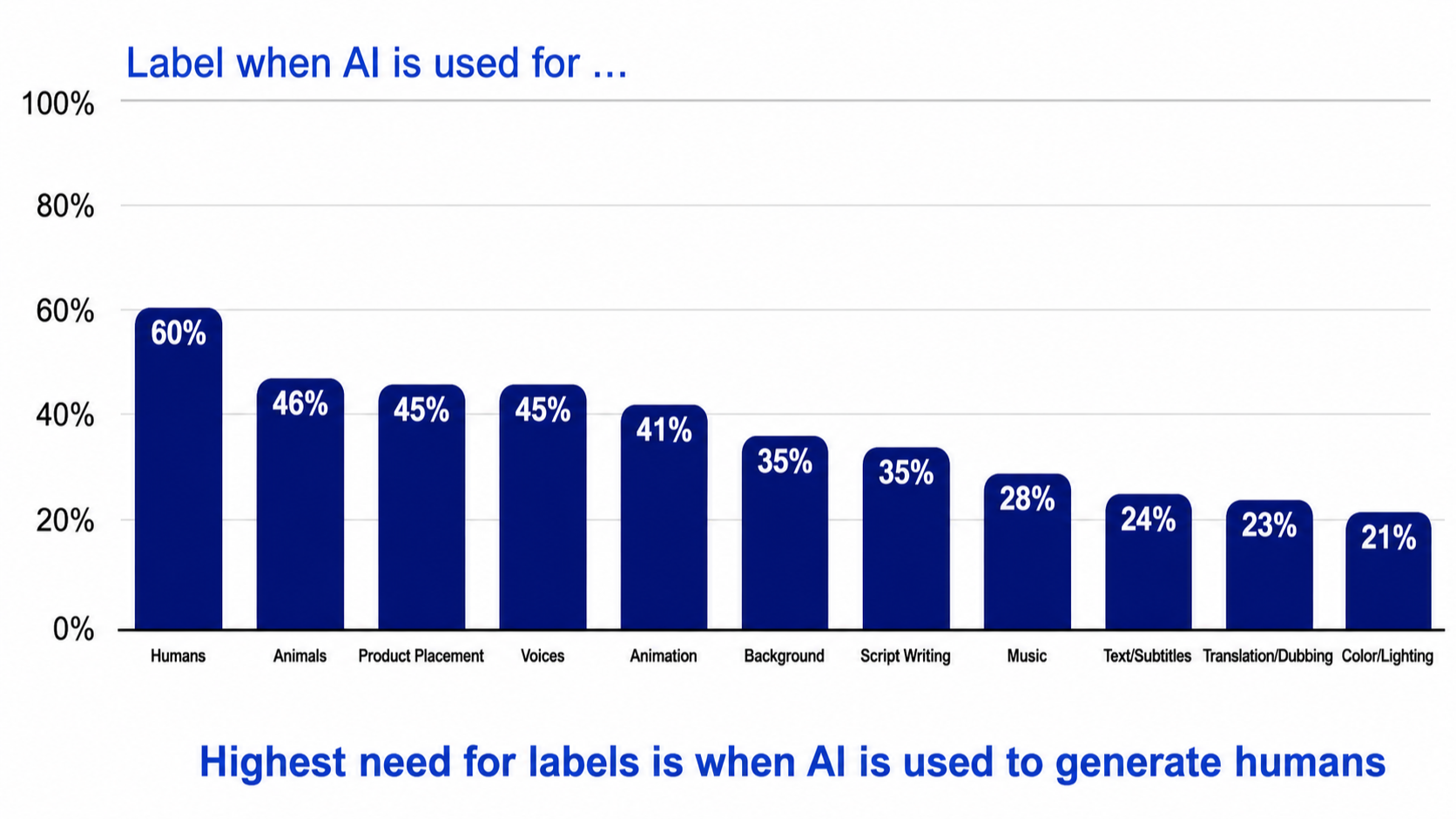
- Demand for transparency: The audience expects AI labeling most strongly when neural networks are used to generate human likenesses (60% of respondents). This was followed by animals (46%), product placement (45%), and voiceovers (45%).
Dr. Duane Varan, CEO of MediaScience, emphasized that the industry’s anxiety has proven groundless: if the creative execution and the video itself are of high quality, disclosing the technology poses no threat. Advertisers should not fear the incoming regulations.
The study arrives at a critical moment as regulatory compliance deadlines loom: New York’s AI transparency law in advertising is set to take effect in June 2026, followed by the European Union’s AI Act, which will mandate strict disclosure requirements starting in August 2026.
Source: TVTechnology