

⚖️ How the creative industry and courts are tackling AI content authorship
The rapid advancement of generative artificial intelligence (GenAI) has permanently reshaped the audiovisual landscape. Neural networks have become everyday operational tools across filmmaking, graphic design, advertising, and digital platforms.
However, Russian intellectual property law has historically been anchored in a classic anthropocentric model, which recognizes authorship exclusively for human beings who have made a personal creative contribution. Consequently, a state of legal uncertainty has emerged in the market, directly impacting investment models and the allocation of commercial risks. Telesputnik has published an expert review analyzing where the boundary lies between AI as a technical utility and AI as an autonomous content creator.
Three Perspectives on the Authorship of AI Works
Domestic and global legal doctrines have currently coalesced around three primary approaches regarding ownership rights over a generated product:
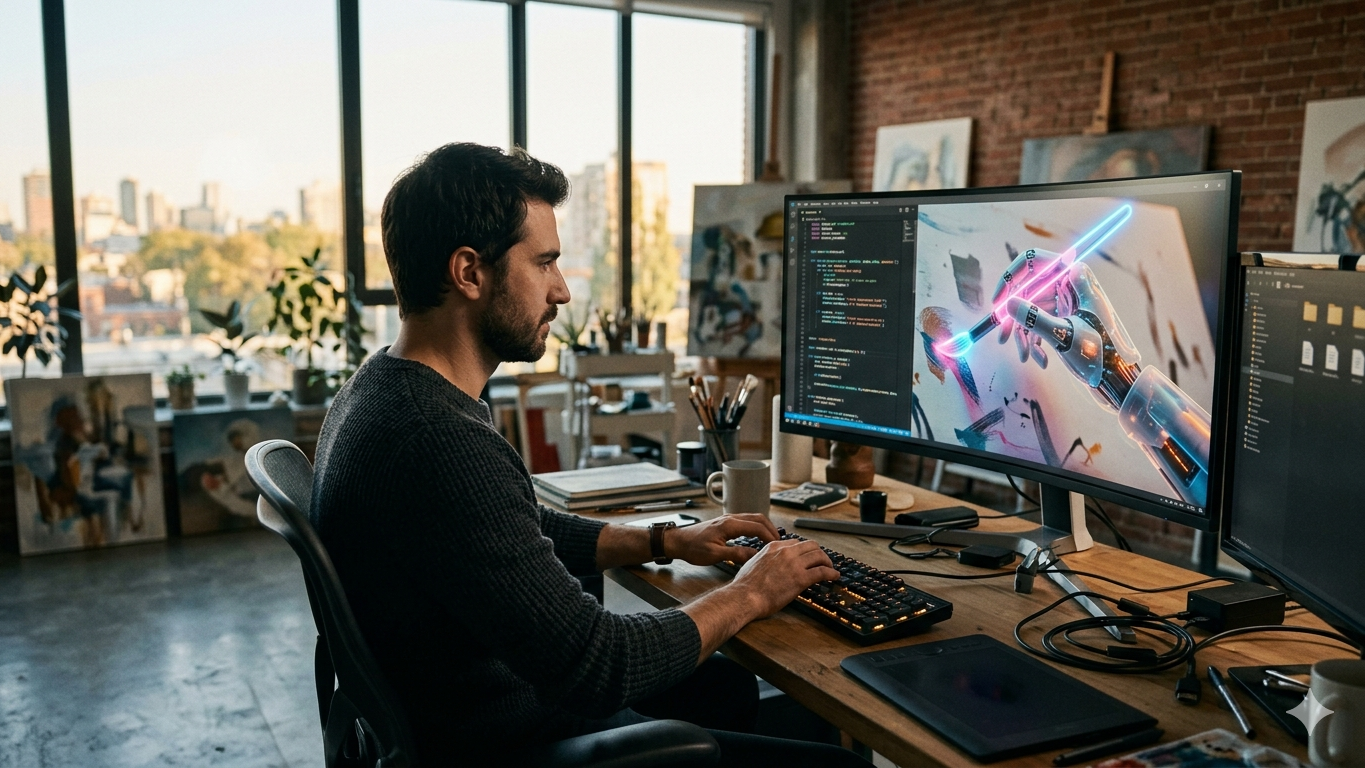
- The Anthropocentric Approach (The Prompter as Author): This stands as the most prominent concept. The neural network is viewed as a complex analog to a paintbrush, a camera, or a text editor. Without a human director defining the aesthetic choices and operational parameters, the AI creates nothing. Proponents of this view argue that legal protection must be afforded directly to the user, who holds an immediate commercial and creative interest in safeguarding the asset.
- AI as a Legal Entity (The “Electronic Person”): This approach treats self-learning AI as an independent creator, given that a prompter often inputs a simplistic, single-word query (e.g., “draw a flower”) and cannot predict the style, color palette, or final composition with absolute certainty. While WIPO reports note instances where AI has been credited as a co-author, there is currently no baseline within the Russian legal framework (under Article 1347 of the Civil Code of the Russian Federation) to recognize legal rights for a machine.
- The AI Developer as Author: This hypothesis is largely deemed untenable by experts. While the platform’s rightsholder owns the copyright to the software itself (the source code and interface), they exert zero influence over the final output of any specific user generation and remain entirely unaware of its creation.
Judicial Practice and “Soft Regulation”
While legislators prepare a formal regulatory framework—for instance, the draft Federal Law “On State Regulation of AI” introduced in 2026, which mandates content labeling, is not scheduled to take effect until September 1, 2027—the courts are assuming a pivotal role.
Global and domestic precedents demonstrate that judicial bodies lean toward protecting human rights provided that deep creative control over the process can be proven. For example, in November 2023, the Intellectual Property Court in China recognized copyright protection for a prompter because they had iteratively rewritten queries and adjusted parameters to reflect individual judgment. That same month, the Moscow Arbitration Court adjudicated a dispute involving the unauthorized use of a video utilizing deepfake technology. The court ruled that deploying AI during the editing phase served merely as a supplementary technical tool for material processing, and thus did not negate the original creative contribution of the production crew (the screenwriter, director of photography, and motion designer).
To effectively filter out content involving minimal human intervention, experts propose utilizing criteria of “subjective creativity” (evaluating the volume of prompt iterations). Alternatively, they suggest reforming the absolute nature of copyright by granting protection only to those AI assets in whose commercialization authors and brands hold a direct stake (such as music videos, commercials, and feature films), while leaving casual, everyday generations in an unprotected legal gray zone.
Liability for Model Training
Another pressing issue within the creative economy centers on the legality of the datasets used to train neural networks. Lawsuits brought by thousands of artists against Midjourney confirm that the risk of compiling copyrighted works without a license is immense.
Experts draw an analogy to the evolution of social media platforms, which long benefited from “safe harbor” doctrines that immunized them against liability for user-generated pirated content. Today, the global trend has reversed (as seen in EU Directive 2019/790), requiring platform operators to proactively negotiate licensing terms with rightsholders. Under Russian law, AI generation derived from copyrighted images is legally classified as an unauthorized “derivative modification of a work.”
In response, tech giants like Google and Microsoft are already implementing internal filtering mechanisms and committing to indemnify their users against legal claims. In the long term, this trajectory could diminish the availability of free neural networks and accelerate the creation of closed, licensed data repositories designed for safe AI training.
Source: Telesputnik