


📡 Satellite TV Retains Strategic Relevance
Analytical agency TelecomDaily has presented a study of the Russian satellite television market covering the period from 2022 to 2030. In the wake of the March anomaly on the Express-AT1 spacecraft, an industry-wide debate has emerged regarding the reliability of orbital signal delivery.
Nevertheless, the findings of data analyses and expert surveys prove that satellite technology has no viable alternative in Russia. The inherent vulnerability of a single point of failure is offset by global advantages: total independence from local internet infrastructure and the ability to cover vast territories.
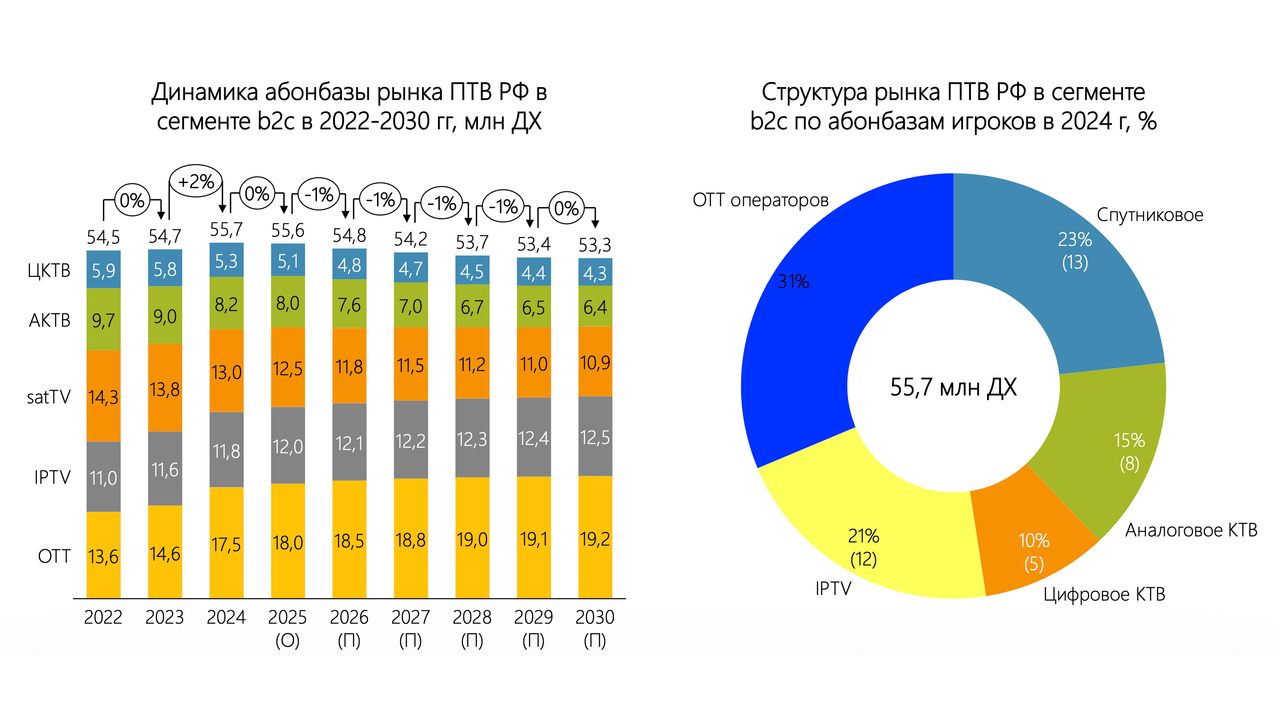
By the end of 2025, satellite TV was utilized by 25.7 million households (including both pay-TV and free-to-air FTA models). In the pay-TV segment, satellite holds a 23% market share (12.5 million subscribers), successfully competing with cable TV (25%) and outperforming IPTV (21%). Analysts project that by 2030, traditional cable networks will lose up to 15% of their subscriber base, while the share of SatTV will stabilize at 32% of the market. Furthermore, driven by free-to-air broadcasting, the total satellite subscriber base will continue to grow moderately, reaching 26.1 million households by 2030.
Economics and Geographical Factors
The primary driver of the technology’s development in Russia is its cost-effectiveness in remote and hard-to-reach areas. In a country where the population density is just 8.5 people per square kilometer, and approximately 35% to 40% of the landmass lacks terrestrial TV coverage, laying cable or constructing LTE towers is economically unviable.
A comparative cost analysis of connecting a single subscriber in sparsely populated areas reveals:
- LTE tower construction (mobile operators): 35,000 RUB
- Terrestrial line deployment (cable providers): 25,000 RUB
- IPTV infrastructure: 22,000 RUB
- Satellite connection (SatTV): just 5,000 RUB
Furthermore, the total cost of ownership (TCO) for satellite infrastructure in rural areas is 3 to 5 times lower than that of terrestrial alternatives, with “last mile” expenses completely eliminated. Consequently, more than 60% of rural residents rely on satellite TV. Interestingly, the technology is also strengthening its footprint in major metropolitan areas (with penetration rising to 27.2% in cities with a population over one million), where urban residents utilize satellite as a reliable backup communications channel in the event of mobile network outages.
Technological Transformation and Sovereignty
Modern satellite TV has long evolved past the concept of a “mere dish and receiver.” In 2025, 1.1 million new subscriber units were sold in Russia. Today, hybrid receivers (SatTV + OTT) have become the industry standard: linear programming and bandwidth-heavy 4K content are delivered directly from space without overloading terrestrial networks, while interactive services, catch-up archives, and personalized AI recommendation systems are loaded via the internet.
Operators are demonstrating strong financial resilience. While maintaining a stable subscriber base, their revenues grew by 43% between 2019 and 2025 due to an increase in ARPU. Viewers are willing to pay a premium for high-quality content and interactive features, with up to 42% of surveyed users utilizing pause and rewind options daily.
TelecomDaily experts emphasize that the satellite constellation is not merely a commercial tool, but the cornerstone of national information security and technological sovereignty. In the event of large-scale emergencies, power grid failures, or damage to fiber-optic trunk lines, the satellite signal continues to stream directly to the user’s antenna. When equipped with household uninterruptible power supplies (UPS), receiving systems can operate autonomously for up to 6 to 8 hours, ensuring citizens maintain guaranteed access to information.
Evidently, the segment requires long-term state planning and capacity reservation for 15 to 20 years into the future, as a full replacement for the lost Express-AT1 satellite is not expected to be launched into orbit until 2029–2030.
Source: TelecomDaily