


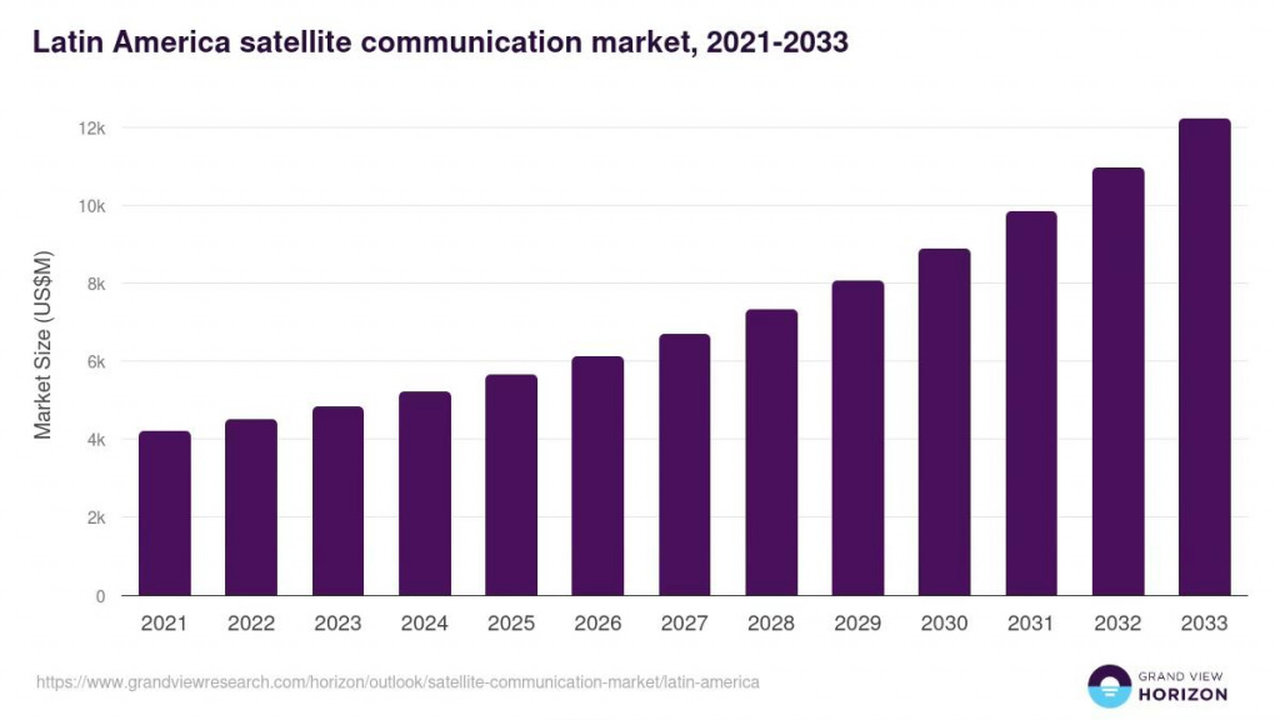

💫 Latin America Experiences Satellite Boom
The Latin American satellite communications market is undergoing a large-scale technological transformation. The region's complex geography—characterized by the impenetrable Amazon rainforest and the Andean mountain ranges—combined with underdeveloped terrestrial infrastructure, has traditionally driven high demand for space-based communications.
However, in 2026, it is the deployment of Low Earth Orbit (LEO) constellations and the commercial rollout of Direct-to-Device (D2D) services that have triggered a genuine investment boom.
Market Drivers and New Entrants
At the end of 2025, the Latin American satellite communications market revenue was valued at $5.65 billion (accounting for 5.7% of the global volume). Analysts project that by 2033, this metric will more than double to $12.21 billion, exhibiting a compound annual growth rate (CAGR) of 10.3%. Brazil, Mexico, and Argentina remain the largest national markets. Furthermore, although large-scale construction of fiber-optic communication lines is slated for completion across the region by 2030, the specifics of real-world consumption indicate that even with technical coverage reaching 90% of households, no more than 60% of subscribers will actually utilize fiber broadband. This leaves a colossal niche for satellite broadband operators: by 2030, the number of satellite connections in the region’s key countries is expected to expand by 43%, reaching 3.4 million.
SpaceX’s Starlink currently stands as the undisputed leader in the region. Year-over-year data (comparing Q1 2025 to Q1 2026) reveals that the operator’s subscriber base skyrocketed by a record 450% in Brazil and by 159% in Argentina. These two countries now account for over 22% of all active Starlink users globally, whereas a year ago, Latin America’s entire market share did not exceed 5%. This explosive growth is driven by aggressive marketing tactics and a “low base effect.” Starlink is actively penetrating the mass market with a “lite” tariff priced at $35–$40 per month, competing directly with 5G Fixed Wireless Access (FWA), which costs an average of $30.
Several global players are prepared to challenge SpaceX’s monopoly:
- Amazon LEO (Project Kuiper), in partnership with DirecTV Latin America and SKY Brazil, aims to reach 15 million corporate clients across nine countries, promising speeds of up to 1 Gbps for the B2B segment. The deployment will initiate in southern latitudes, specifically Argentine Patagonia and Chile.
- China’s Spacesail Technologies has achieved a geopolitical breakthrough. In February 2026, the Brazilian regulator Anatel officially granted the company a commercial operating license, making Brazil the first nation in the region to open its market to the Chinese LEO network.
Geostationary Sector Consolidation and the MSS Segment
In the traditional Geostationary Earth Orbit (GEO) market, asset consolidation emerged as the defining event, highlighted by the operator SES acquiring Intelsat. The transaction allowed SES to assume control over more than 50 satellites covering the region, securing a dominant position in the GEO segment, which currently features over 70 C- and Ku-band spacecraft and 24 advanced Ka-band satellites. As revenues from broadcasting traditional media content continue to decline, GEO operators are pivoting toward the corporate sector, government institutions, and Mobile Satellite Services (MSS).
The Latin American MSS market is projected to grow from $683.9 million in 2024 to $1.75 billion by 2030 (at a CAGR of 16.9%). Capitalizing on this trend, SES has already secured a contract with the Mexican low-cost carrier Viva to connect 100 Airbus aircraft. Concurrently, Frequentis, in cooperation with Brazil’s Department of Air Space Control, is modernizing the air traffic control network in the Amazon region using VSAT terminals to enhance flight safety.
Commercial Breakthrough of D2D Technology
In 2026, Direct-to-Device (D2D) technology officially transitioned out of the pilot phase. The Chilean operator Entel, which had introduced satellite SMS features in late 2025, became the first in Latin America to launch full commercial mobile connectivity via the Starlink Direct-to-Cell constellation on March 25, 2026. Within the first month of operation, 450,000 users gained access to the service as part of standard tariff plans (priced at approximately $14 per month).
In parallel, Liberty Latin America is preparing launches in Jamaica, Panama, and Costa Rica, while competitor AST SpaceMobile has garnered backing from telecom giants Telefonica and America Movil, securing a D2D broadcasting license in Brazil. Amazon has also entered the mobile segment fray: in April, the company acquired the operator Globalstar for $11.57 billion. The acquisition grants Amazon immediate access to a coordinated global frequency spectrum and emergency connectivity provider status for Apple devices (iPhone and Apple Watch), allowing it to establish a foothold in the D2D market well ahead of the full deployment of its own network in 2028.
Amid fierce competition, the region’s regulators are making concessions to bridge the digital divide. For instance, Bolivia has completely abolished restrictions on global satellite broadband providers, while the Argentine regulator ENACOM has allocated additional frequencies to Starlink and unified licensing procedures, transforming Latin America into one of the most open and dynamic testing grounds for space communication technologies.
Source: SatComRus