



🎬 Russian Film Exports Stagnate Ahead of Expected Breakthrough
The international box office for Russian cinema during the first quarter of 2026 shows signs of flattening at a lower threshold. According to analysts, 12 domestic feature-length projects were in distribution outside the Russian Federation and the CIS during the first three months of the year, generating a cumulative total of $2.54 million.
This figure is virtually identical to the $2.62 million recorded during the equivalent period last year, but it represents a dramatic contraction compared to Q1 2024, when revenues reached $11 million. While the market has successfully restructured its footprint, it has hit an invisible ceiling: not a single Russian film managed to breach the $1 million milestone in overseas box office returns during the reporting cycle.
In the global ranking of local content exporters, Russia currently occupies 11th place, lagging substantially behind market leaders Japan ($40.2 million for the quarter) and South Korea ($29.8 million).
Box Office Leaders and Geographic Focus
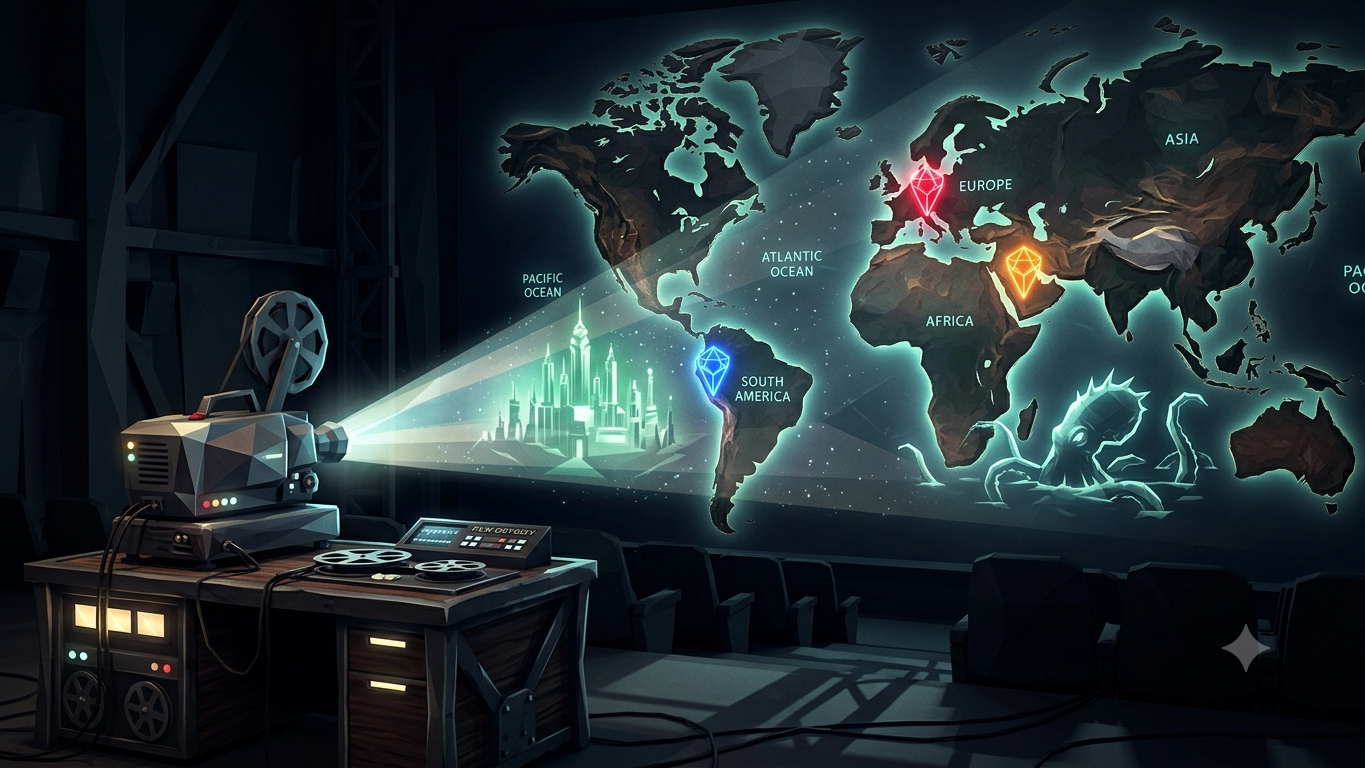
The sci-fi blockbuster Kraken led the international chart for the quarter, capturing $533,000. The project drew its primary box office from four Latin American territories, with Peru emerging as the main catalyst, contributing $339,000 (120,000 admissions).
Securing the runner-up position was the animated sequel Finnick 2 with $403,000. The project registered the widest geographic footprint of the quarter, spanning seven territories, led by Romania ($135,000) and Poland ($97,000). Third place went to another animated release, Dolphin Boy 2, which grossed $372,000, with Saudi Arabia acting as its anchor market ($205,000).
The fantasy feature Buratino claimed fourth place, earning $337,000 across 12 territories. Anastasiya Korchagina, CEO of Art Pictures Distribution, notes that the theatrical strategy relied heavily on the global recognition of the classic Pinocchio narrative:
“Driven by high character recognition, the fantasy title has already been licensed to over 50 countries. Generally, genre-specific projects and films rooted in recognizable international intellectual properties remain in the highest demand among foreign buyers today.”
Rounding out the top five was The Wizard of the Emerald City: The Yellow Brick Road, which accumulated $272,000 solely on the strength of a successful theatrical release in Italy.
The Battle of Distributors
In the sales house competitive landscape, Luminescence took the lead by a razor-thin margin, with six of its titles grossing a combined $949,000 across 28 territories. A strategy built on portfolio diversification and a strong emphasis on independent animation (Cats in the Hermitage 2, Doctor Aybolit, Finnick 2) allowed the company to edge out Central Partnership Sales House, which generated $937,000 across three releases. Art Pictures Distribution finalized the top three with $337,000.
Juraj Barabas, Managing Director of Luminescence, emphasizes that the current deceleration is a reflection of global economic pressures rather than content origin:
“The global economy is navigating a period of turbulence, which impacts independent film consumption with particular severity. Licensing fees for features worldwide are facing downward pressure. We are managing to sustain a baseline performance primarily due to robust, long-term partnerships.”
Pricing Pressures and Emerging Markets
The steep discount international buyers demand when acquiring Russian content remains the industry’s most pressing challenge. Experts widely agree that overseas partners are leveraging the vulnerable position of Russian exporters, offering licensing fees substantially below global market averages (such as comparisons to equivalent content originating from Spain or South Korea).
Katerina Pshenitsyna, International Business Development Director at Soyuzmultfilm, points out that while animation remains the bedrock of exports (accounting for roughly $1 million of the quarter’s total gross), live-action features are beginning to anchor themselves in new territories. However, reversing the current pricing trend will require high-profile commercial precedents:
“At this juncture, it is critical for our films to demonstrate truly breakout box office metrics in key territories. This would help re-engage international buyers and establish vital leverage to drive licensing fees upward.”
Without the emergence of major tentpoles capable of independently generating millions of dollars in overseas box office receipts, the annual export potential of Russian cinema risks remaining locked in a modest $8 million to $10 million corridor.
Source: Kinometro