



📊 Analysts Identify Metadata Crisis in FAST Sector
Amagi, the cloud-based SaaS platform for broadcasting, streaming, and monetization, has released the 17th edition of its AIRTIME Report, focusing on global trends within the Free Ad-Supported Streaming TV (FAST) segment.
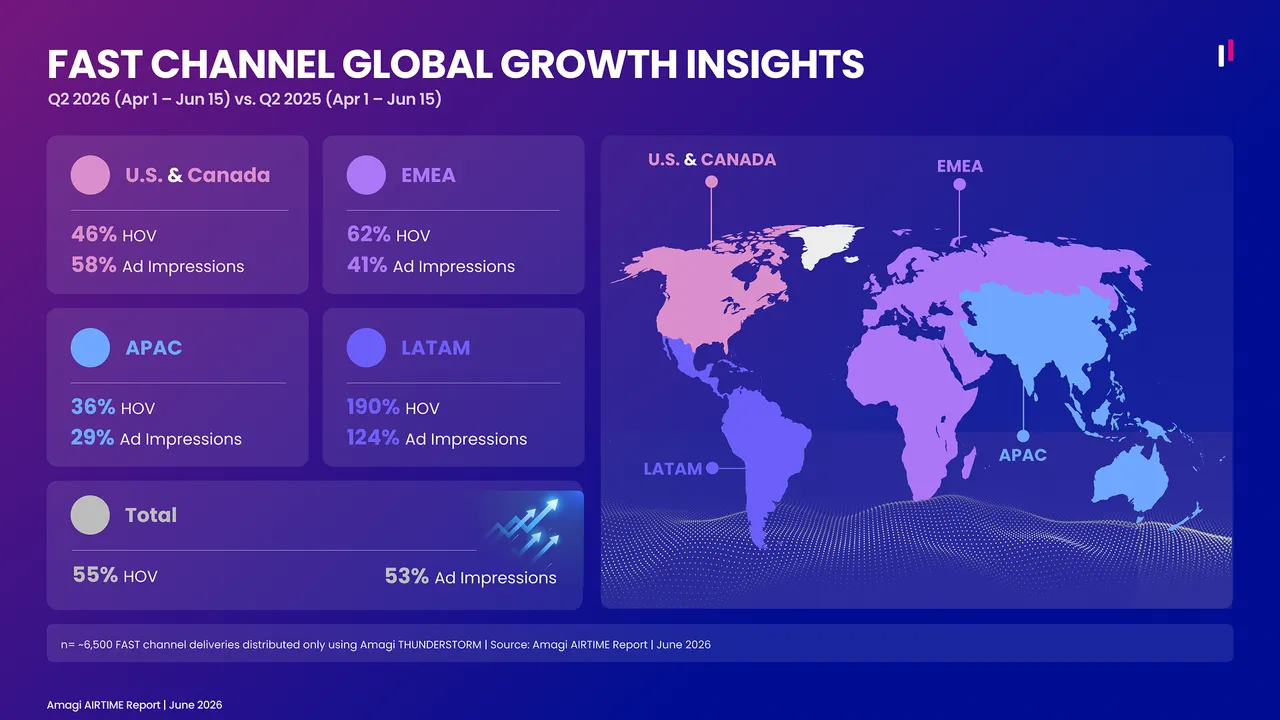
The study is anchored in data analytics from approximately 6,500 FAST channels delivered via Amagi’s Thunderstorm server-side ad insertion (SSAI) platform between April 1 and June 15, 2026.
The global FAST market continues to exhibit strong upward momentum: worldwide Hours of Viewing (HOV) jumped 55% compared to the equivalent period in 2025, while ad impressions increased by 53%. The United States and Canada remain the dominant monetization regions, generating 54% of global viewing time and 74% of ad impressions. The most explosive regional growth was recorded in Latin America (+190% in HOV), driven by an aggressive portfolio expansion of localized channels.
In terms of genres, unscripted and scripted entertainment content leads with 41% of viewership. News channels, while commanding 27% of audience time, generate 33% of ad impressions, cementing their status as the most efficient monetization tool. The biggest surprise of the period came from kids’ content, which saw its HOV skyrocket by a record 191% year-over-year.
The central focus of the study highlights the operational and commercial liabilities stemming from inaccurate or incomplete metadata across the entire media supply chain. Amagi surveyed 28 C-level executives and heads of operations, product, and programming departments at major broadcasters, platforms, and ad networks. The findings exposed severe structural vulnerabilities:
- Revenue Losses and Operational Drag. 86% of respondents stated that constantly formatting and mapping metadata to comply with the disparate requirements of hundreds of FAST platforms represents the primary operational bottleneck for their businesses. An identical 86% acknowledged that poor metadata directly causes revenue leaks due to ad monetizability failures, degraded discovery recommendations, and the deprioritization of content by platform algorithms.
- Substandard Ingest Data. 71% of those surveyed noted that metadata arriving from content owners is increasingly incomplete—frequently lacking precise genres, ratings, artwork, or episodic numbering—and indicated that this issue is worsening.
- AI as an Operational Solution. 57% of industry professionals confirmed that artificial intelligence technologies are already capable of generating synopses, tags, and genres reliably enough that humans are only required for spot-checking. Furthermore, 68% anticipate that within three years, AI will ingest and execute virtually the entire content tagging process with minimal operator oversight.
- Platform Hegemony. 68% of market participants project that within three years, unified metadata standards will be strictly dictated by the largest streaming platforms rather than content creators.
Reflecting these priorities, 32% of companies identified the implementation of advanced, AI-driven automated tagging tools as their top investment focus for the next 12 months.
“The metadata that wins is the metadata that can be ingested and parsed by agents, both human and artificial intelligence. Poor metadata doesn’t just look sloppy on an EPG grid anymore; it becomes completely invisible to the systems that drive discovery,” noted Gavin Bridge, Chief Analyst at FASTMaster, summarizing the strategic gravity of the issue.
Commenting on the report’s conclusions, Srinivasan KA, Co-founder and President of Amagi, added:
“The FAST segment has secured its place at the very core of the modern media stack. This report makes it clear that the next competitive frontier will not be about scale, but operational precision. Metadata is the nexus where content discovery, advertising monetization, and audience intelligence converge.”
Source: Advanced Television