


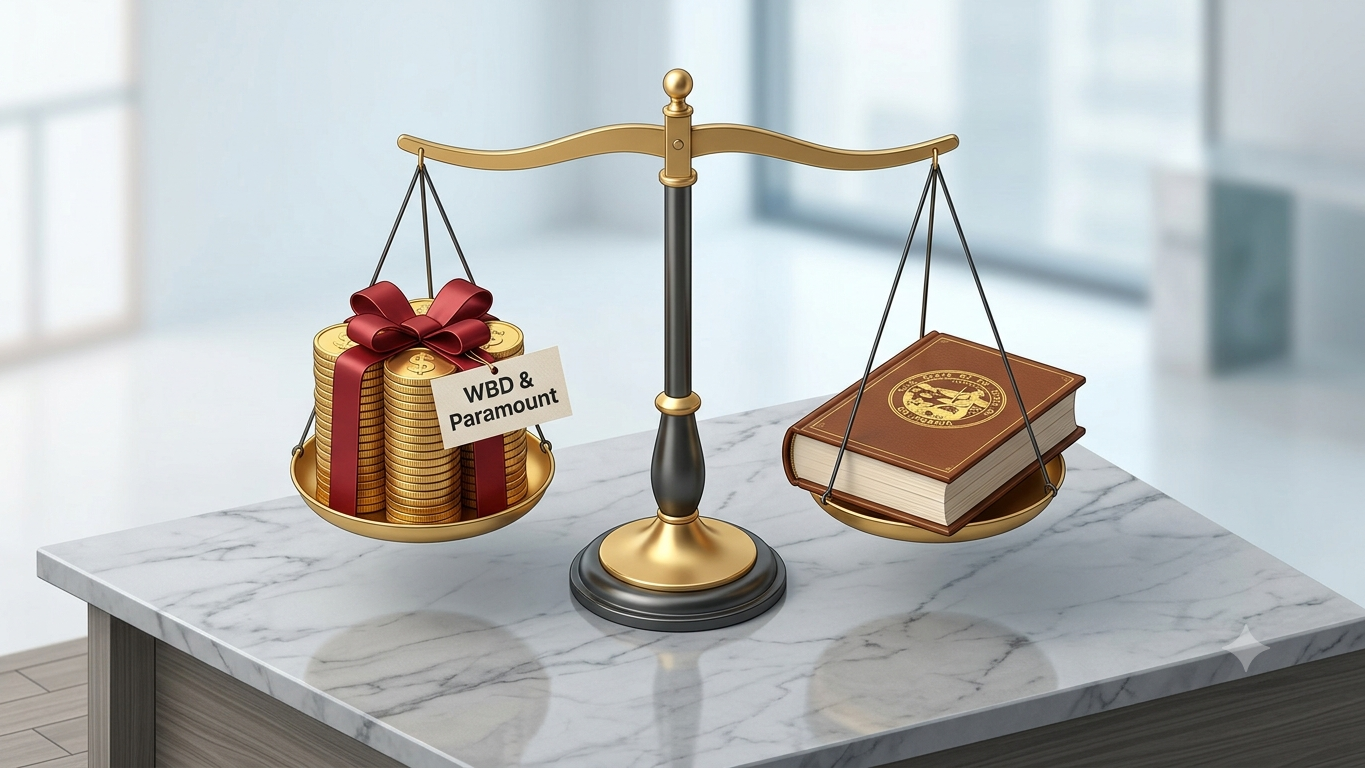

🙅♂️ States File Lawsuit to Block Paramount-WBD Merger
The consolidation of US media giants has run into powerful legal resistance at the state level. A coalition of 12 state attorneys general, led by California, has filed a sweeping antitrust lawsuit in a California federal court seeking to block the $111 billion merger of Paramount and Warner Bros. Discovery (WBD).
The move represents a direct intervention by state authorities into Hollywood’s largest transaction, occurring at a time when the Donald Trump administration is signaling a highly permissive stance toward media mergers.
The plaintiffs, who also include the attorneys general of Arizona, Colorado, New York, and other states, allege a flagrant violation of the Clayton Antitrust Act. They argue that combining two of the world’s five major film studios will monopolize the market, putting over 85% of wide-release theatrical distribution and more than 30% of blockbusters under the control of a single entity. According to the lawsuit, this will inevitably trigger ticket price hikes, diminish content diversity, and exert immense pressure on theaters, which would be forced to surrender a larger share of box office receipts to the distributor. The prosecutors are demanding the transaction be halted pending a court ruling, warning they will otherwise file for a temporary restraining order.
For Paramount, any delays in the process carry catastrophic financial risks. Under the terms of the merger agreement, if the transaction fails to close by September 30, 2026, the company must pay WBD shareholders a penalty of approximately $650 million for each quarter of delay (equivalent to roughly $6.9 million per day).
“There is no room for debate here: this merger will stifle competition, drive up prices, lower the quality of content, and result in fewer movies and shows being produced each year,” stated California Attorney General Rob Bonta.
Bonta also explicitly highlighted the political context surrounding the deal, pointing to the ties between the Ellison family (Paramount CEO David Ellison is the son of Oracle co-founder Larry Ellison) and Donald Trump. In June, the US Department of Justice cleared the acquisition unconditionally without requiring any asset divestitures, fueling rumors of political favoritism—particularly since the deal will hand control of CNN over to the Ellisons.
Paramount Skydance fired back with a sharp statement, calling the lawsuit “fundamentally flawed as a matter of both fact and law.” The company maintains that the merger is critical to building a robust player capable of competing with tech monopolists like Netflix, Amazon, and Google, which currently dominate the market and disrupt the traditional theatrical distribution model. According to Paramount, the lawsuit merely shields the dominant positions of big tech streaming platforms at the expense of content creators and Hollywood jobs.
To date, the deal has cleared regulatory hurdles in 24 jurisdictions, including China, South Africa, and several European nations. However, Paramount is still awaiting verdicts from the US Federal Communications Commission (FCC), as well as antitrust regulators in the UK and the European Commission.
Industry analysts agree that this looming courtroom battle could drag on for years, jeopardizing David Ellison’s ambitious plans to forge a new media conglomerate saddled with an estimated $79 billion debt load.
Source: Hollywood Reporter