



🛒 RKN Reports Decline in 'White' Digital Advertising Volume
The Russian interactive advertising market has encountered a significant discrepancy between official government statistics and expert estimates from leading industry associations.
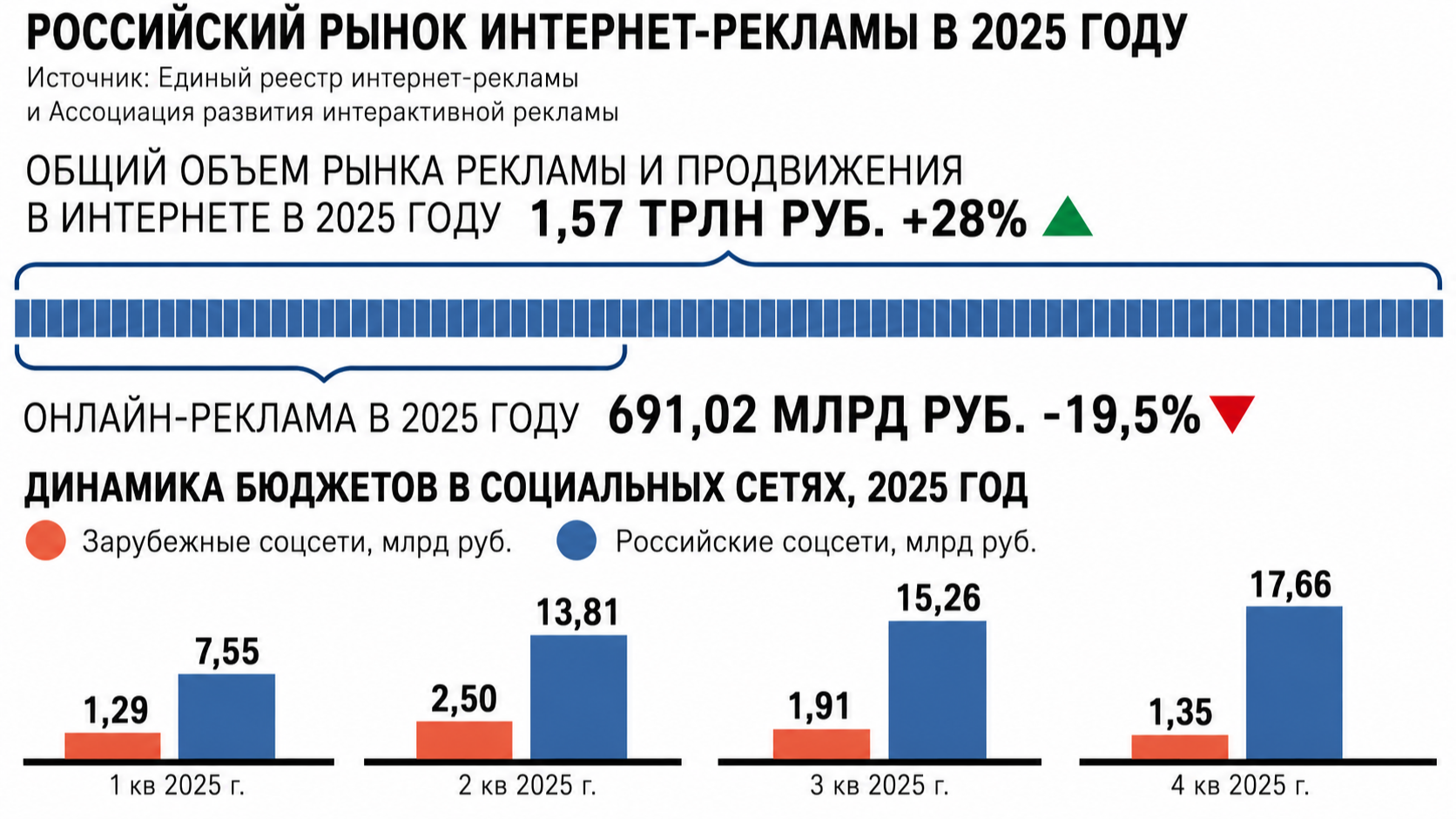
According to the annual report released by Roskomnadzor (RKN), the volume of officially tracked budgets in the Unified Registry of Internet Advertising (ERIR) totaled 691 billion rubles in 2025—representing a 19.5% decline year-on-year.
This downward trend was reflected not only in financial terms but also in the sheer volume of market participants. The number of unique advertisers registered in the system decreased from 1.3 million in 2024 to 1.25 million in 2025. Meanwhile, the distribution of ad spend remained highly concentrated, with the largest players commanding nearly two-thirds (approximately 66%) of all financial flows.
Three key sectors of the economy maintained their leading positions in terms of digital promotion spending:
- Wholesale and Retail Trade: 180.5 billion rubles (27.4% of the total volume)
- IT and Telecom: 103.5 billion rubles (15.7%)
- Financial Sector: 75.9 billion rubles (11.5%)
Real estate developers and construction companies secured the fourth spot with 47.4 billion rubles (7.2%), followed by the automotive sector in fifth with 30.6 billion rubles (4.6%).
Such a sharp contraction in ERIR-reported figures stands in stark contrast to market performance reports from major industry bodies. Specifically, the Russian Association of Communication Agencies (AKAR) previously reported 9% growth in the digital advertising segment, while the Interactive Advertising Bureau (IAB) Russia / ARIR declared a staggering 28% expansion in the digital promotion market.
Industry experts attribute this paradox to fundamental differences in accounting methodology. The government registry (ERIR) operates strictly with verified, fully labeled ad spend processed through Advertising Data Operators (ERIR-compliant ODOs), representing the “fully transparent, white market.” Conversely, AKAR and ARIR analysts utilize a comprehensive modeling approach that factors in rapidly growing alternative channels that elude traditional reporting:
- E-retail Media: Promotional spending within online marketplaces.
- Influencer Marketing: Native integrations with bloggers and content creators.
- Closed-Ecosystem Messaging: Advertising within messaging apps, primarily Telegram.
Specialists attribute the drop in registered registry volumes to two main factors: the optimization of marketing budgets by small and medium-sized enterprises (SMEs) under macroeconomic pressure, and a deliberate migration of ad spend into “gray zones” or communication formats that in practice bypass mandatory ad-labeling regulations.
Source: Vedomosti