



🛰 D2D Technologies Reshape the Telecom Landscape in Asia and Australia
The Direct-to-Device (D2D, or Direct-to-Cell) satellite communications market, which enables standard smartphones to connect directly to spacecraft without intermediate hardware, is experiencing a phase of rapid commercial deployment.
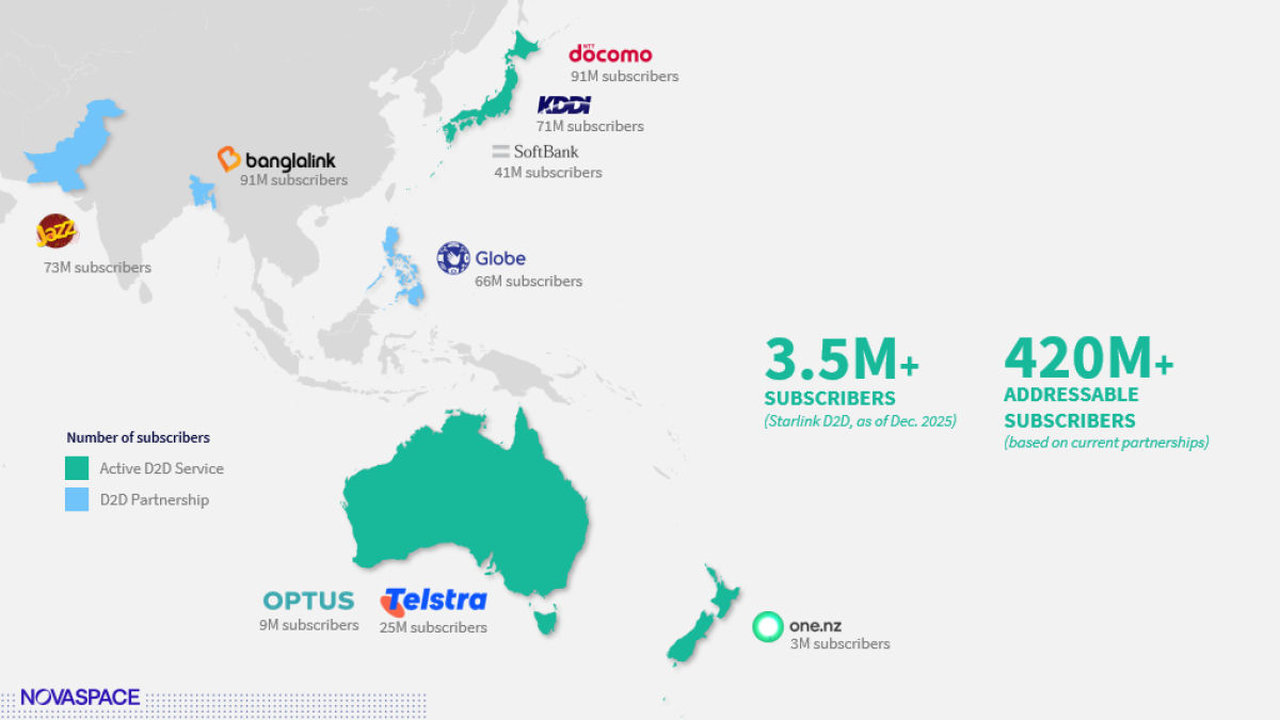
According to Novaspace, the Asia-Pacific (APAC) region has emerged as the primary catalyst for this technological revolution. Recent industry data indicates that, driven largely by the activity of the Starlink constellation, the number of D2D subscribers in APAC countries has surpassed 3.5 million. SpaceX’s established partnerships with regional mobile network operators (MNOs) open access to a potential addressable market of over 420 million subscribers, turning the macro-region into the premier proving ground for extraterrestrial cellular coverage.
Commercial Launch Pioneers
Japan has set the first true commercial benchmark in the APAC region. By integrating with Starlink satellites, local telecom giant KDDI expanded its coverage across 40% of the country’s territory that was previously inaccessible to terrestrial base stations. Within just a few months of launch, the service’s subscriber base exceeded 1 million users, and in August, the operator became the first in the world to commercialize direct data services to unmodified consumer smartphones. However, the D2D penetration rate in Japan still stands at a modest 0.11% of total mobile users, a reflection of the country’s high urban density and the minimal time citizens spend in coverage blind spots.
A completely different dynamic is unfolding in Australia and New Zealand:
- Australia: Driven by partnerships between operators Optus and Telstra and Starlink, the focus is on eliminating black spots that cover 60% of the continent. The country currently accounts for 18.1% of all global D2D connections, ranking second worldwide behind the United States.
- New Zealand: The country has set an absolute global record for service penetration at 1.41% of its total national cellular base, fueled by challenging island topography and a high volume of tourism in remote locations.
China’s Sovereign Path
The development of D2D infrastructure in the PRC is following an isolated, strictly state-coordinated trajectory. Licenses to provide satellite mobile services have been granted to all members of the “Big Three”—China Mobile, China Unicom, and China Telecom (the latter has already scaled its solutions into the Hong Kong and Laotian markets).
In the medium term, Chinese operators are expected to phase out foreign providers in favor of national low-Earth orbit (LEO) mega-constellations: Guowang (the national network) and G60 Qianfan. The objective of this integration is the deployment of a sovereign broadband D2D ecosystem completely independent of Western counterparts. Thanks to the synergy between operators, chipset manufacturers, and network equipment plants, China is positioned to establish the world’s largest isolated space communications market by the end of the decade.
Technological Maturity of Key Players
The global race among D2D providers is led by Starlink, which has launched more than 650 cell-capable spacecraft into orbit. Its recent acquisition of frequency spectrum from EchoStar could bring the performance characteristics of Starlink’s satellite signals closer to the parameters of terrestrial LTE/5G networks.
Alternative consortia are closely trailing the market leader:
- AST SpaceMobile: Holds the second-most significant position, anchoring its growth on strategic partnerships in Japan and India. Backed by a portfolio of secured future revenues exceeding $1 billion, the company is bypassing short-messaging phases to focus immediately on “heavy” broadband data.
- Lynk Global & Omnispace: This alliance, supported by satellite giant SES, is developing a hybrid, multi-band approach. It combines spectrum leasing from traditional cellular operators with a globally coordinated S-band MSS spectrum.
In parallel with the traditional operator model, a vendor-driven alternative is emerging. Apple’s integration of Globalstar’s emergency satellite messaging directly into the iPhone architecture demonstrates that consumer device manufacturers are forging a powerful, independent B2C channel for D2D, completely removing cellular operators from the value chain.
Analysts project that over the next 10 years, the compound annual growth rate (CAGR) of D2D subscribers in the APAC region will exceed 40%. In the short term, Japan is expected to generate the highest revenue due to strong ARPU metrics. In the long run, India is projected to dominate in terms of raw subscriber volume due to its vast territory—provided regulatory frameworks are streamlined and smartphones equipped with satellite-compatible chips become more affordable. However, technological and ecosystem leadership is poised to remain firmly with the PRC.