

🎂 German Digital TV Celebrates 30th Anniversary
On July 28, 1996, Germany launched its first digital television platform, DF1, created by media mogul Leo Kirch. While commercially the venture ended in a staggering financial collapse, technologically it proved to be a defining watershed moment in the history of global broadcasting.
Thirty years later, “digital television” has ceased to be a standalone product or marketing buzzword: it has evolved into the invisible technological foundation underpinning all modern media services—from traditional terrestrial and cable networks to streaming services, IPTV, and FAST platforms.
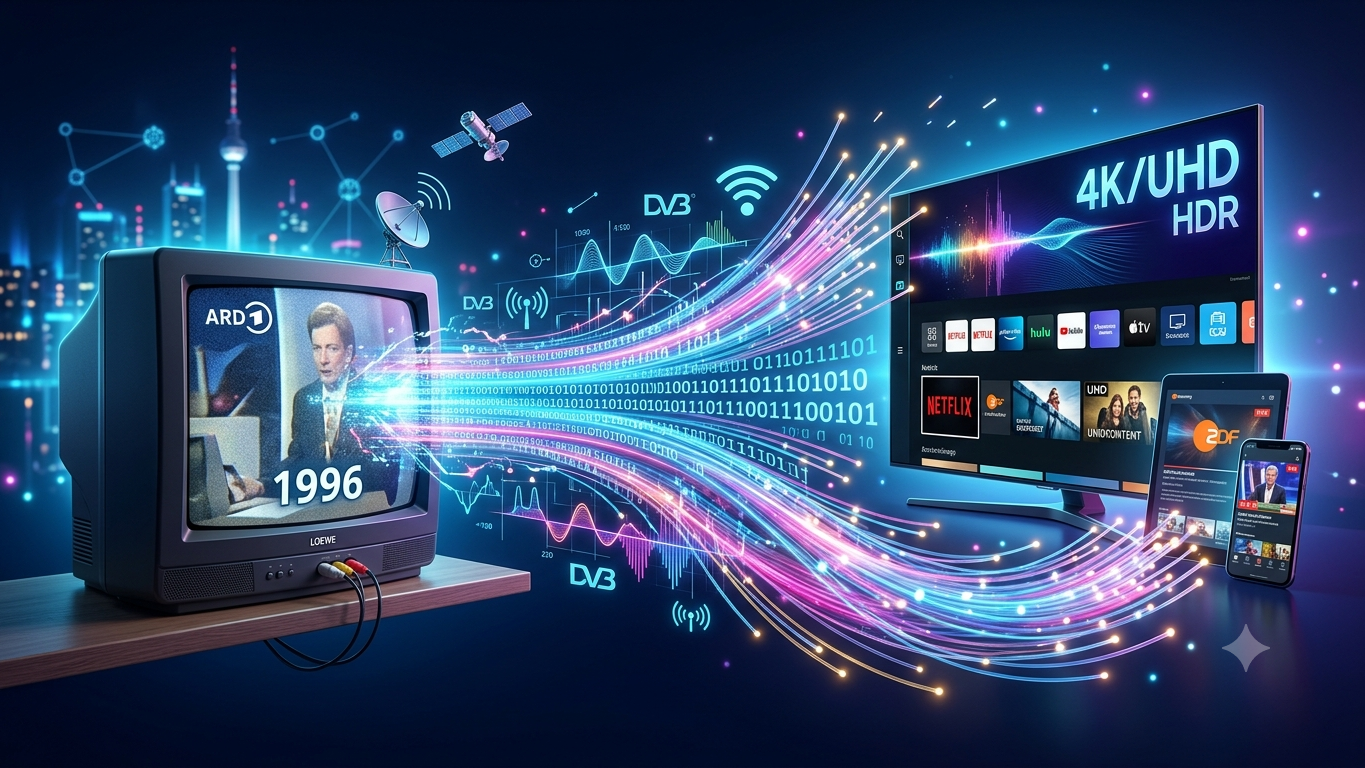
The migration from analog signals to digital data streams fundamentally reshaped the industry. Advanced compression formats (MPEG-2, MPEG-4 AVC/H.264, and HEVC/H.265) enabled multiplexing multiple channels onto a single frequency, ushering in the era of HD and UHD broadcasting. Meanwhile, the development of the DVB family of standards (DVB-S/S2, DVB-C/C2, DVB-T/T2) permanently blurred the line between linear broadcasting and data transmission. As broadband networks expanded, television naturally transformed into an IP-based service, while the entire production chain—from digital cameras and server-based editing to automated cloud playout—became fully digitized.
The transition away from analog occurred in distinct phases: the analog satellite sunset in 2012 and the complete decommission of analog cable networks by 2019 marked the end of an era. More recently, the summer 2024 repeal of Germany’s “privilege clause” (Nebenkostenprivilegium)—which previously bundled cable TV fees into tenant utility bills—levelled the playing field between traditional broadcasting, OTT services, and streaming platforms.
Today, the paradox of digital TV lies in its total victory: the term “digital” has fallen out of use precisely because no other form of television exists anywhere in the world.
Source: Digital Fernsehen