


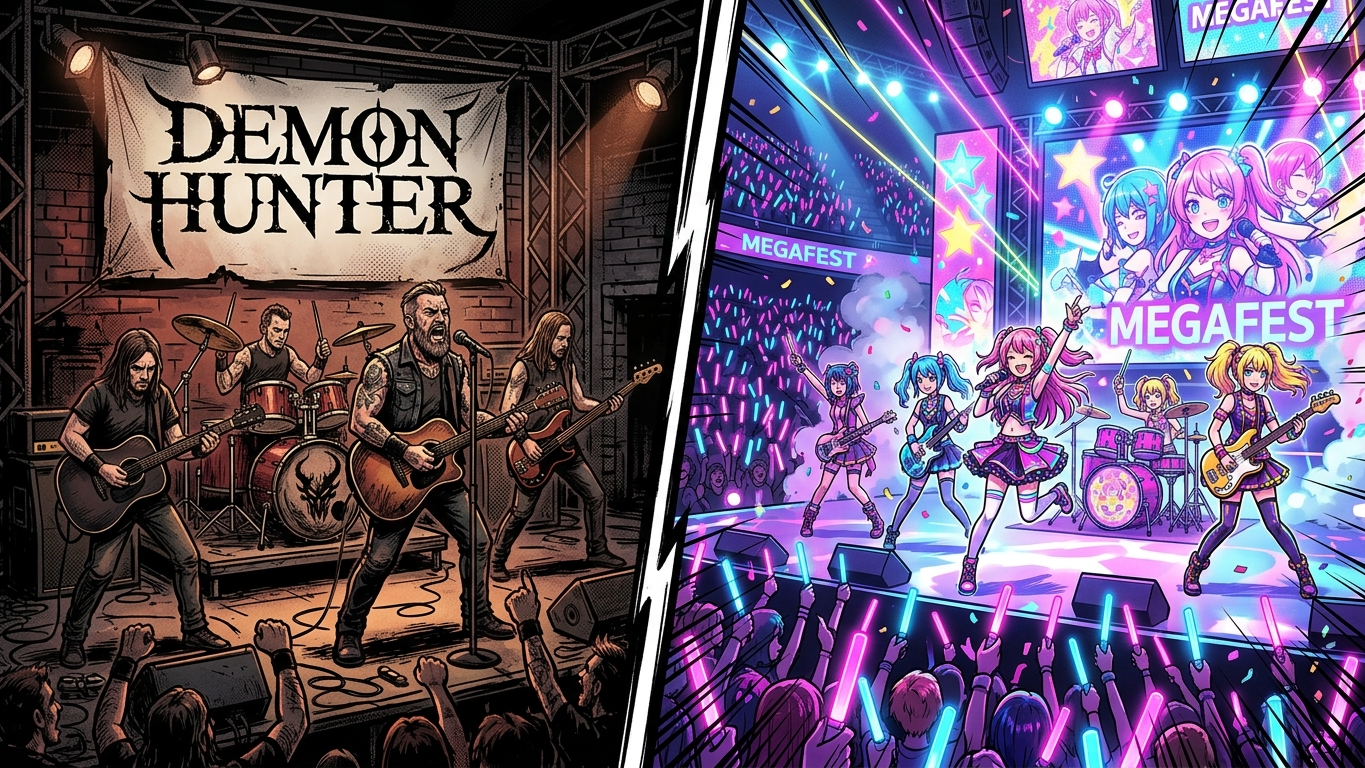

👹 Metal Band Demon Hunter Sues Netflix
American heavy metal band Demon Hunter and their parent company, Hyde Lane, have filed a lawsuit in US federal court against streaming giant Netflix, its subsidiary Netflix Studios, and major global concert promoter AEG Presents.
The musicians accuse the defendants of trademark infringement, unfair competition, and false designation of origin.
The massive legal battle stems from the phenomenal success of the animated film K-Pop Demon Hunters, which premiered on Netflix in June 2025 and became the most-watched project in the platform’s history. The movie swept the awards season, winning an Oscar, a Golden Globe, and a Grammy for the track “Golden,” recorded by the fictional K-pop group HUNTR/X.
Brand Boundaries and Commercial Confusion
Founded in Seattle around 2000, Demon Hunter has actively performed under the moniker for a quarter-century. Over this period, the band released 13 albums, established a prominent presence in the Christian metal scene, and officially registered the corresponding trademarks for entertainment services under Hyde Lane.
While the project initially existed solely as film content, Netflix subsequently expanded it into a global franchise—launching merchandise lines, filing new trademark applications, and announcing a 150-city concert tour in partnership with AEG Presents. The musicians contend that this aggressive push into live music and touring directly diluted their brand and triggered widespread consumer confusion.
- Ticketing mishaps: One fan spent nearly $500 on premium tickets to a Demon Hunter metal show, erroneously believing he was buying passes to the K-Pop Demon Hunters production for his children.
- Industry disorientation: Television producers reached out to the band’s management assuming an affiliation with Netflix, while search engine and social media algorithms became overwhelmed by content related to the animated film.
The band emphasizes the stark asymmetry in promotional scale: Demon Hunter draws roughly 350,000 monthly listeners on Spotify, whereas the film’s soundtrack garners over 27 million. The complaint draws a comparison to a hypothetical “K-Pop Metallica,” arguing that prefixing a genre label like “K-Pop” fails to eliminate confusion when the core identifier overlaps with an established trademark.
A Legal Precedent for Media Franchises
The plaintiffs are asking the court to formally enjoin Netflix and AEG Presents from using the name K-Pop Demon Hunters in connection with music distribution, merchandise, and live performances, as well as to award damages and disgorge profits derived from the franchise.
The upcoming trial poses a major precedent for the broader media ecosystem. The court will have to delineate the boundaries of trademark protection in an era where successful screen IP rapidly morphs into vast live-entertainment ecosystems, directly colliding with legacy brand holders.
Source: DesignTAXI

In Russia