


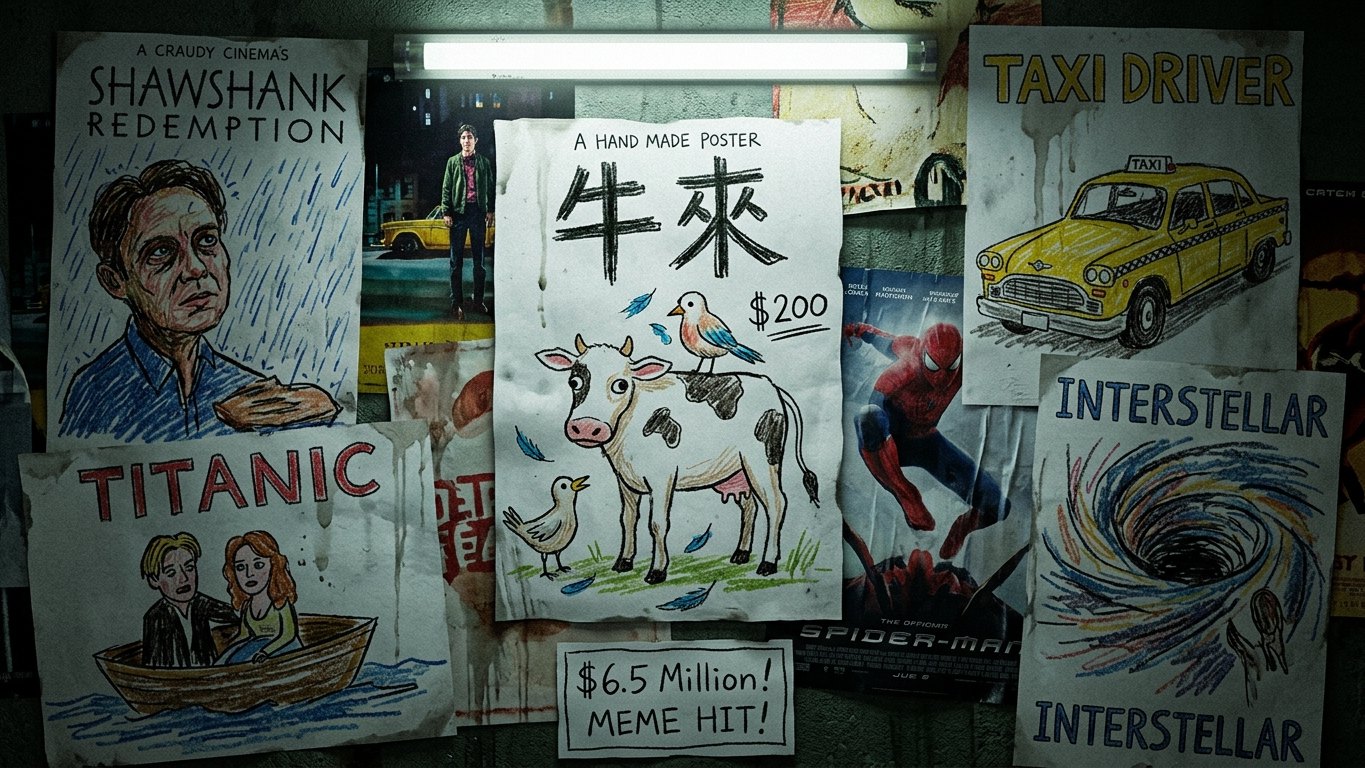

🐮 Low-Budget Chinese Animated Film Becomes a Viral Phenomenon
In a surprise twist for the entire film industry, the animated feature Niu Lai (which translates to "Here Comes the Cow") has turned into one of China's biggest box office hits.
Produced on an astonishingly modest budget of $200, the film grossed over $6.5 million in just three weeks of theatrical release. These figures were confirmed by Maoyan, China’s largest ticketing platform.
This phenomenal rise makes the story behind Niu Lai truly unique. The film premiered on August 5 to an audience of just 122 people. Initially, it faced harsh criticism for its crude visuals, illogical plot, and vague message. Over its first ten days, theatrical earnings reached just over ¥7,000. Then came a dramatic spike: by August 16, box office receipts surged past ¥4 million. Leading global media outlets, including the BBC, The Guardian, and SCMP, are now comparing the title to Hollywood blockbusters such as Spider-Man: Brand New Day and The Odyssey. For context, the new Spider-Man pulled in $221.4 million at the Chinese box office, while The Odyssey took in $35.9 million. Though Niu Lai’s earnings are considerably smaller, they prove that this micro-budget project is holding its own in popularity against industry giants.
A Mother-and-Son Duo
The film was created by Sun Lifang and Xin Yumeng, a mother-and-son creative team who spent five years working on the project. The 86-minute storyline centers on the journey of a newborn calf and an injured skylark through an abstract dreamscape.
Online buzz proved to be the key driver of its success, effectively turning the movie into a meme. The phenomenon is largely tied to a “so bad it’s good” dynamic. As The Guardian noted, “It is the polar opposite of the slick, polished animated features that have drawn massive crowds in China in recent years.”
Niu Lai had neither a official trailer nor a standard marketing campaign—the creators released only a single poster that reportedly had almost no bearing on the actual content. This prompted cinema staff to hand-draw their own promotional posters to lure moviegoers. Internet users quickly joined the trend, creating AI-generated parodies of posters for famous films.
Financial Speculation and Contrast with AI
Some audience members bought tickets purely as a good luck charm due to the film’s title. Niu Lai is a homophone for the phrase “the bull market is coming,” used to describe market surges that drive up stock prices. Beyond that, viewer interest is driven by the sharp contrast the movie presents to modern technology. Against the backdrop of ubiquitous high-definition visuals and generative AI reshaping the industry—enabling studios to pump out content at minimal cost—Niu Lai stands out as the genuine effort of just two people.
Niu Lai demonstrates that in an environment where a project can gain momentum long before any massive promotional push, organic online discourse can serve as the primary engine driving a story from the web onto the big screen.
A Mixed Reception
Despite its commercial triumph, reactions to the film remain divided. Chinese state media offered a critical assessment. The Beijing News labeled the picture a failure and urged the industry to tighten its curation standards: “When creators lack true talent and attempt to trick the market with subpar work, who is left to help audiences maintain even a baseline standard of quality?”
At the same time, a section of the audience has embraced the project. One commentator called it a rare find:
“It’s a movie for those who are young at heart—simple and honest, like a bedtime story for children.”
Others are simply riding the viral wave, encapsulated by another viewer’s comment:
“If you watch this movie, you’ll regret it for 80 minutes; but if you don’t watch it, you’ll regret it for the rest of your life.”
Source: AdIndex