

🗣 Up to 75% of TV Content to Be Distributed via the Internet
By 2028–2029, nearly 75% of television content could be distributed via the internet. However, traditional television will not disappear; instead, it will gradually integrate with digital platforms. This forecast was shared by Alexander Zharov, CEO of Gazprom-Media Holding, in an interview with Kommersant.
Simultaneously, the media market will restructure around artificial intelligence, user-generated content, and the battle for audience attention.
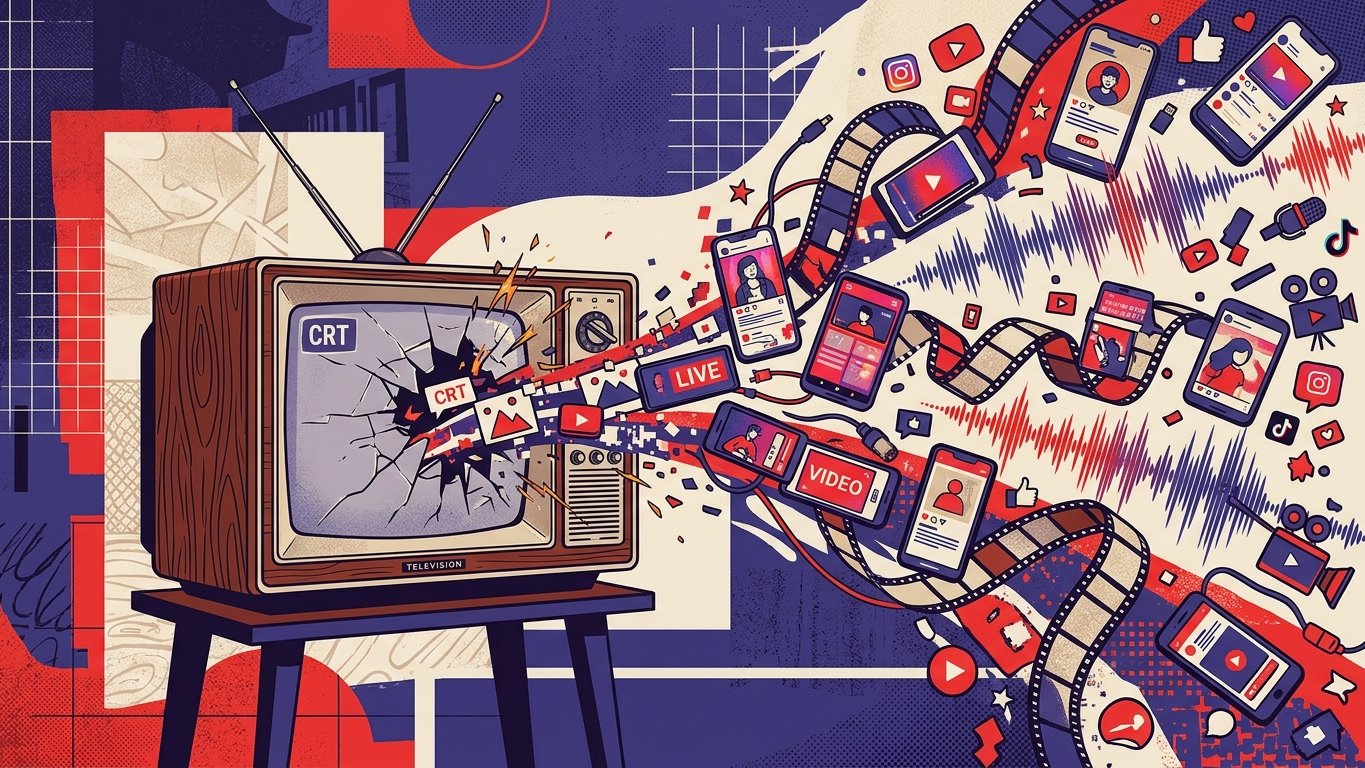
According to Zharov, the primary shift in the coming years will be the further convergence of television and online platforms. TV content will increasingly be distributed concurrently across linear broadcasting, video-sharing platforms, online cinemas, and short-form video.
The head of Gazprom-Media believes it is premature to speak of the demise of television. It will undergo a transformation similar to print media: while a portion of the audience and content migrates to the digital space, the format itself will persist, becoming more niche.
Rutube Targets 30 Million Daily Viewers
The holding views Rutube as a key driver of this transformation. The video platform’s daily active users (DAU) currently exceed 20 million, with a monthly active user base (MAU) of around 80 million. By the end of 2026, the company aims to boost its daily audience to approximately 30 million.
The platform hosts over 450 million videos, with user-generated content (UGC) playing a significant role, accounting for roughly 34% of all uploaded material.
The average user session duration on Rutube stands at around 63 minutes. Over 40% of the audience returns to watch content driven by the platform’s recommendations.
The holding intends to simultaneously develop professional production and user-generated segments. In Zharov’s view, the boundary between the two is blurring: successful bloggers are turning into independent production studios, while TV hosts and other media personalities are actively expanding into digital formats.
Television Expands Beyond the Channel
Gazprom-Media links this model to the concept of “Big TV.” The core idea is to build a digital ecosystem around a television brand, complete with spin-off programming, creators, short clips, and UGC.
Consequently, a single media brand can operate concurrently across broadcast television, video platforms, and social media formats.
Zharov notes that watch time is becoming one of the primary key performance indicators for media products. Competition is no longer confined to rival TV channels or video services; it is a broader fight for total user attention against social networks, marketplaces, banking applications, and other digital services.
In-House Content Production Grows 30% Annually
Following the departure of a significant portion of foreign content, Gazprom-Media is banking on its own production. According to Zharov, its volume has grown by approximately 30% annually since 2022.
The holding now produces over 3,000 hours of original content per year. Previously, foreign projects accounted for about a quarter of its content portfolio.
This shift has provided Russian producers with extra room to develop original series, films, TV shows, and other formats. Concurrently, the role of proprietary intellectual property—which can be distributed across multiple platforms at once—has grown.
AI to Be Integrated at All Stages of Production
Another key trend is the integration of artificial intelligence. At Gazprom-Media, AI is already utilized not only for recommendations and UGC management, but also across financial, legal, HR, and production workflows.
Zharov predicts particularly striking transformations in computer graphics, where AI can significantly cut costs and timelines for creating complex visual effects for movies and TV series.
However, the holding does not view neural networks as a direct replacement for creative professionals. Rather, the technology is expected to handle routine operations and boost the productivity of existing teams.
The company, which employs over 11,000 people, is not currently planning mass layoffs due to AI implementation.
Rutube Shorts Merges Short-Form Video with the Main Platform
Short-form video represents another strategic direction. The former Yappy platform is being technologically integrated into Rutube and the holding’s other services. Rutube Shorts already boasts over 500,000 regular users and is primarily targeted at a younger demographic.
In effect, Gazprom-Media is constructing a unified video ecosystem where a short video can serve as a gateway to longer television or film content.
Bloggers Become Part of Professional TV
Zharov separately highlighted the evolving role of content creators. Successful bloggers today increasingly operate like full-fledged media companies—complete with dedicated teams, production facilities, marketing, and ad integrations.
In 2025, Gazprom-Media distributed around 1.5 billion rubles in ad revenue to bloggers. In 2026, Rutube expects to nearly triple its ad-supported revenue model compared to the previous year.
For traditional television, this offers a fresh pipeline for talent and content. Bloggers are transitioning into TV series and broadcast projects, while television stars are expanding onto digital platforms.
Next Stage: AI Regulation and Copyright
Zharov considers the use of copyrighted content in training neural networks to be one of the most complex challenges facing the media market.
He asserts that rights holders must be compensated when their films, music, images, or texts are used to train AI models. Achieving this will require clear rules and tracking mechanisms for utilized content—a framework Gazprom-Media believes could take several more years to develop.
What This Means for the Market
The forecasts from Gazprom-Media’s CEO indicate that the Russian media market is moving toward a model where the boundaries separating television, video platforms, the blogosphere, and online streaming services will progressively dissolve.
Television content will be produced with multi-channel distribution in mind from the outset, bloggers will integrate into the professional media landscape, and AI will serve as a foundational technology at nearly every stage of content creation and promotion.
Ultimately, the primary metric of the media business is shifting from audience size to watch time. It is over this user attention that television channels, video platforms, and other digital services will compete in the coming years.
Source: Kommersant