

🏀 Artificial Intelligence Is Transforming Sports Broadcasting
Sports media production is undergoing a technological transformation, with generative AI at its core. From deepfakes of legendary commentators to automated animation and computer vision, broadcasters and leagues are striving to strike a balance between scaling content and preserving the human touch of sports.
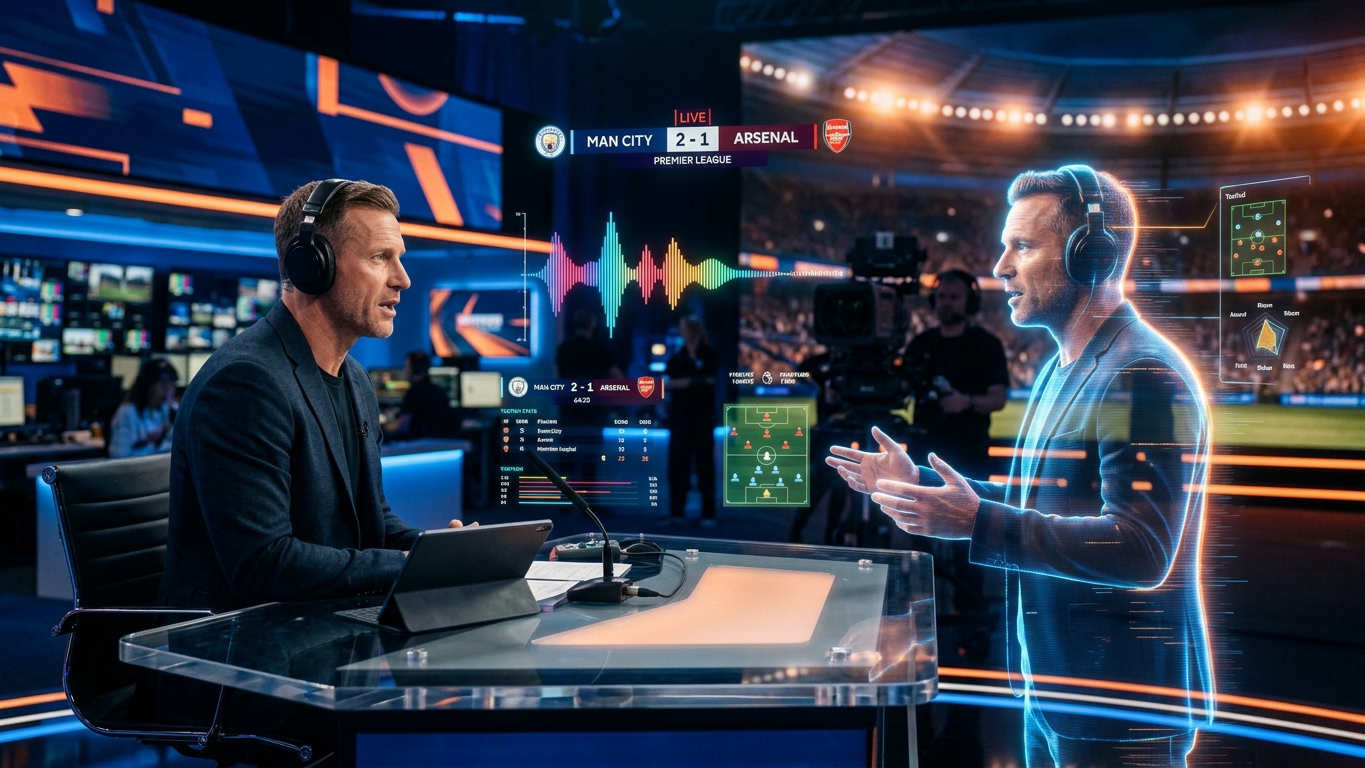
Technological advancements have reached a point where top US commentators are seriously considering establishing digital twins. Some are already exploring the licensing of their AI-cloned voices for future broadcasts—effectively entering into “lifetime and perpetual” contracts. NBC took a similar step at an official level by recreating, with his family’s consent, the voice of legendary announcer Jim Fagan—who passed away in 2017—for NBA basketball telecasts.
Major media companies are deploying generative AI across vastly different areas:
- Content Personalization and Scaling. For a year now, ESPN has been successfully expanding its SportsCenter for You project, where synthesized host voices create tailored morning digests based on individual user interests. This enables the daily voiceover production for hundreds of local games that real announcers simply do not have the bandwidth to cover.
- Generative Production and Animation. The NBA, in partnership with WSC, launched a children’s YouTube show featuring AI characters (Alley, Oop, and Buzzer). Generative engines handle the routine tasks of storyboarding, animation, and voiceovers, cutting episode production cycles from several weeks to a couple of days.
- Real-Time Data and Advanced Graphics. On Amazon Prime Video’s Thursday Night Football broadcasts, AI algorithms analyze pre-snap player positioning in real time, highlighting the most probable plays. Meanwhile, Telemundo and HeyGen integrate virtual studios directly into live broadcasts.
However, as the adoption of neural networks accelerates, skepticism is also on the rise. According to a recent IBM study surveying 20,000 fans, the share of users who trust AI-generated content in sports dropped from 63% to 59%. These concerns stem both from the risks of deepfake misinformation—which several NFL commentators have already encountered—and the threat of losing raw emotional impact.
Consequently, some broadcasters are recalibrating their strategies. For instance, in its work with Wimbledon and the US Open, IBM is shifting its focus away from automated highlight commentary toward deep data analytics (including computer vision to assess serve quality) and written match reports. Similarly, NASCAR explicitly stated that replacing live dubbing with AI voices undermines the emotional connection with fans, confirming the league’s intent to stick with traditional broadcasting formats.
Source: Hollywood Reporter