

📺 Television Is Moving to IT
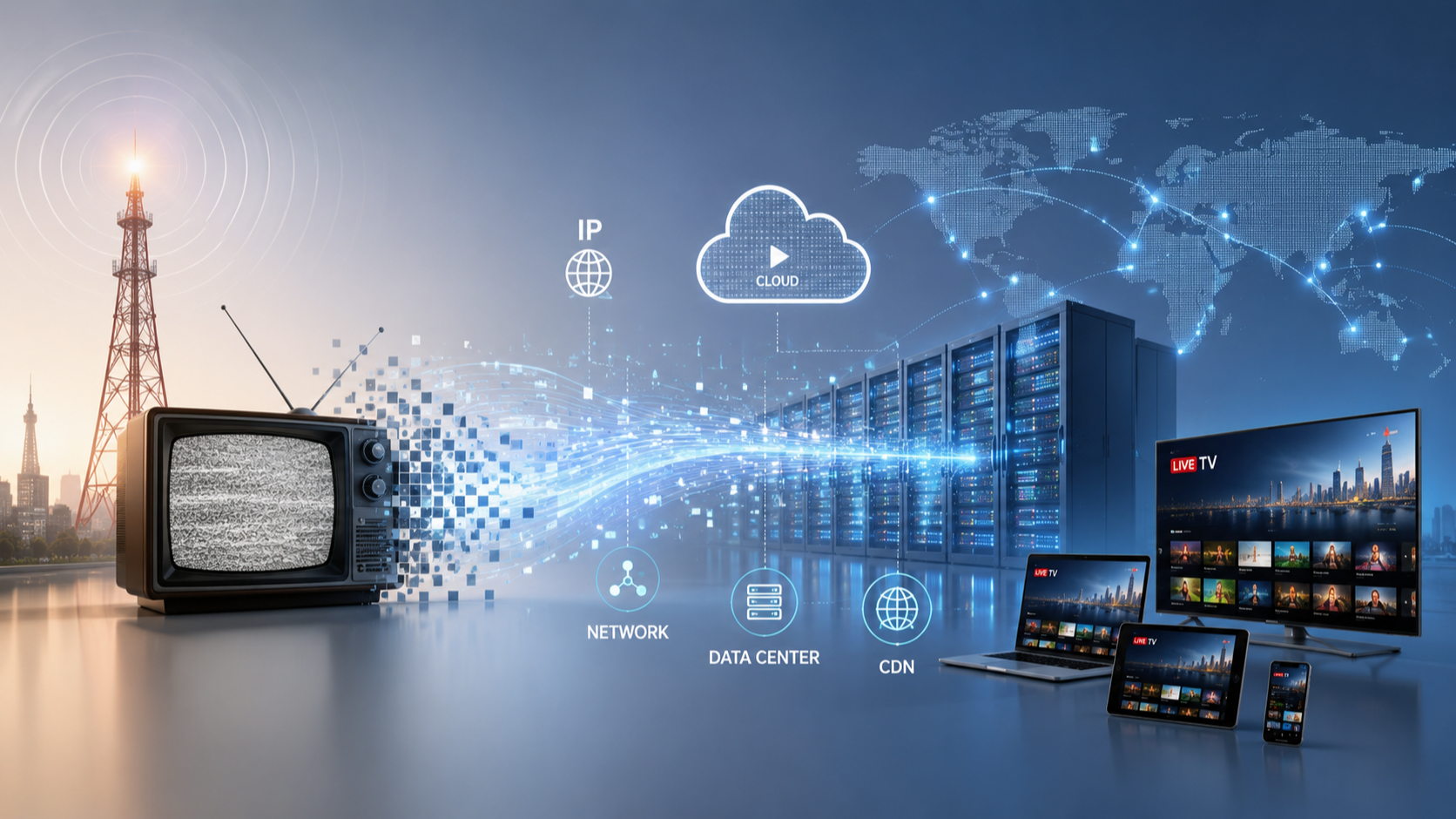
The Russian media industry is entering a period where television is ceasing to be an isolated technological domain. While cable and satellite delivery remain in place, an increasing number of processes are transitioning into the IP environment, data centers, and the cloud.
It is not just the signal distribution methods that are evolving, but the entire economics of the industry: content storage and prep, playout, advertising, compliance, analytics, and rights management are becoming software-defined services.
This is not merely another upgrade of television hardware. A fundamental shift is taking place from specialized broadcast infrastructure to a unified digital architecture.
Two Levels of Digital Transformation
It is important to distinguish between two levels of this transformation.
The first is technological. Television has long been digital in terms of signal formats, but a significant portion of the industry still operates within a specialized broadcast environment—relying on proprietary interfaces, protocols, hardware suites, and dedicated facilities. True digital transformation begins when a video stream becomes a standard data flow delivered over generic IP networks.
IP turns television from an isolated technology into an integral part of the broader IT environment. Such a stream can be routed between data centers, directed to cloud services, automatically processed, backed up, monitored, and integrated with other systems via standard APIs.
The second level is economic and organizational. Migrating to IP alone does not guarantee efficiency. If storage resides in one system, playout in another, compliance in a third, delivery in a fourth, and advertising and analytics are patched in through standalone projects, the digital environment remains fragmented.
The next step is consolidating these processes into a single software-defined ecosystem. This does not mean that every component must belong to one vendor or be housed in a single location. On the contrary, such an ecosystem should be built on open interfaces, distributed infrastructure, and the ability to replace individual services without overhauling the entire system.
Unity must be achieved through a shared data, control, and automation environment—not through rigid lock-in to a single tech stack or facility.
From TV Control Rooms to Data Center Resources
The traditional television model was built around specialized master control rooms and studio hardware suites. Equipment was procured, and dedicated engineering infrastructure was built from scratch for every new project.
This model is expensive far beyond the construction phase. A dedicated facility requires ongoing maintenance, upgrades, and redundancy provisions. This drives up capital expenditures.
In today’s reality, where media organizations must simultaneously trim expenses and accelerate time-to-market for new products, maintaining standalone infrastructure exclusively for broadcast workflows is becoming increasingly unjustifiable.
Data centers and cloud environments offer a different set of economics. Compute, storage, and network resources can be shared across multiple services and dynamically scaled based on demand. Launching a new channel no longer requires building another hardware suite—it is done by allocating software resources.
A hybrid model is proving optimal for television. Systems that are latency-sensitive or require a physical presence can remain on-premises. Meanwhile, storage, processing, redundancy, playout, versioning, ad insertion, and analytics are progressively migrating to data centers and the cloud. As IP networks evolve, the line between local and remote infrastructure is blurring.
IP Television Operates on a Mass Scale
Global experience demonstrates that IP infrastructure is now fully capable of serving not only niche projects, but the largest media operations in the world.
In the UK, Paramount-owned Channel 5 relies on AWS MediaLive and MediaPackage to prepare and deliver video streams, while server-side ad insertion (SSAI) enables monetization control within the digital environment.
In China, Guangdong Radio and Television is building an IP-based production infrastructure for remote workflows in 4K, 8K, and HDR. In this architecture, sound stages, production centers, and distribution systems can be geographically dispersed while remaining part of a unified workflow. Meanwhile, Mango TV reported 268 million monthly active mobile users and 75.6 million paying subscribers in 2025.
In India, the number of connected TV households reached 68 million, while the ad market on these devices grew by 42% to 99 billion rupees. The JioHotstar platform attracted over 600 million users in its first three months of operation, with connected TV viewers exceeding 75 million.
In the Middle East, the Shahid platform counted 4.8 million SVOD subscribers and 17.8 million monthly AVOD users in Q3 2024. Over nine months, its revenue reached 805.7 million Saudi riyals, with AVOD advertising revenue more than doubling.
These figures illustrate that IP delivery has become mainstream television infrastructure. It enables not just viewing, but subscriptions, targeted advertising, personalization, data management, and the rapid launch of new channels.
From an Isolated Channel to a Media Ecosystem
In the traditional model, a TV channel was a standalone product with a linear grid and a limited set of delivery channels. In a digital environment, the same content can simultaneously feed a linear broadcast channel, an online cinema, a FAST channel, a mobile app, a Smart TV platform, and social video services.
Samsung TV Plus in Brazil is accessible on more than 22 million devices. The CazéTV platform announced the broadcast of all 104 matches of the 2026 FIFA World Cup on YouTube. During the Brazil vs. Japan match, peak concurrent viewership hit 21.3 million.
FAST is becoming a distinct media market segment. According to S&P Global and Kagan, FAST ad revenue in the US reached approximately $3.9 billion in 2025. Roku expanded its total streaming time from 127.1 billion hours in 2024 to 145.6 billion hours in 2025.
Netflix reported that its ad-supported tier reached over 250 million monthly active viewers worldwide in 2026. Amazon estimated the US audience for Prime Video’s ad-supported tier at over 130 million people. In early 2026, Samsung TV Plus reported over 100 million monthly active users, with watch time on the platform growing by 25% over 2025.
In the UK, data from Everyone TV indicates that during the 2026 World Cup, the share of viewership for England matches in broadband-only households was more than four times higher than in 2022. The Freely service achieved a monthly audience of over 2 million users.
Television can no longer be engineered as a single, linear delivery chain. Modern media systems must be capable of generating different products, versions, schedules, and monetization models from a single content pool.
The Specialized TV Contractor Is Becoming a Redundant Link
The migration of television to IT changes requirements not only for technology, but for service partners as well.
In the past, a large specialized provider could handle the reception, processing, and delivery of TV channels by housing all processes within its own broadcast infrastructure. To the client, this seemed like a convenient way to outsource a complex technological function to a single vendor.
However, this centralized approach is not equivalent to digital transformation.
If all television processes are grouped under a single vendor while remaining trapped inside its proprietary, closed infrastructure, it does not constitute a unified digital ecosystem. Instead, it creates a single point of failure—technologically, organizationally, and commercially.
This is not digital transformation; it is the centralization of an outdated broadcast model.
A narrow specialization in TV services is ceasing to be a competitive advantage on its own. Clients end up paying not just for the service itself, but for maintaining the vendor’s proprietary infrastructure, dedicated facilities, equipment, and operating model. At a time when the industry must optimize costs, such expenses are increasingly difficult to justify.
The Russian Model for a Digital Media Environment
The old model monetized the complexity and exclusivity of broadcast infrastructure. The new model must monetize its simplification, standardization, and integration with general IT infrastructure.
In Russia, this model is being developed by MSK-IX media platforms.
Medialogistika provides IP delivery of TV channels and video streams over the unified MSK-IX network, which interconnects the majority of the country’s data centers. This enables seamless video exchange among broadcasters, operators, streaming platforms, and data centers without building dedicated transport infrastructure for every television project.
Mediabaza allows organizations within this digital environment to handle content storage and prep, compliance, localization, playout, FAST channel launches, metadata management, ad monetization, and analytics.
The value of this model lies not in moving a traditional master control room into someone else’s building, but in eliminating the need to construct a dedicated technological facility for every channel in the first place.
Advertising as a Test of Digital Maturity
Ad monetization highlights the difference between a traditional broadcast system and a digital platform particularly well.
In legacy television, an ad break is part of the linear feed and is identical for all viewers. In an IP environment, advertising can adapt to the platform, region, device type, audience profile, and viewing context. A single video stream can generate customized ad variants for different viewer cohorts.
To achieve this, delivering video over IP is not enough on its own. It requires the deep integration of playout, ad event markers, server-side ad insertion (SSAI), rights management data, audience measurement, and reporting systems.
SCTE-35 markers must pass cleanly through the entire chain. SSAI must operate synchronously with playout and the ad platform. Metadata must contain information about content, rights, and available ad insertion logic. Delivery must remain robust while adhering to legal and compliance restrictions.
Platforms like Harmonic VOS360 combine cloud playout with ad functions, while Zixi solutions are utilized for IP delivery orchestration and management. Systems like these demonstrate that a television stream is no longer a finished end-product, but one of many objects managed within a software-defined media ecosystem.
Data Becomes Infrastructure
Another hallmark of digital maturity is the approach to metadata.
In legacy systems, content data was often scattered across separate spreadsheets, accounting software, and documents. As a result, the exact same media asset carried different titles, descriptions, and IDs at different stages of the production pipeline.
In a digital environment, metadata is as critical to the infrastructure as the video file itself. It dictates where and when content can be aired, its genre, age rating, compliance approval status, embedded ad triggers, and the products in which it can be packaged.
According to Amagi, watch time for FAST content grew by 55% in 2026, while ad impressions rose by 53%. Crucially, 86% of respondents in a survey conducted by the company reported lost revenue directly due to poor metadata quality.
Without a unified data model, it is impossible to efficiently automate channel deployment, localization, ad insertion, recommendation engines, and analytics. If teams are still manually re-entering data between systems, the digital signal format alone does not make production truly digital.
Specialized Hardware Will Remain—Specialized Infrastructure Will Not
The future of television does not lie in a total rejection of specialized hardware. Hardware will persist where it directly interfaces with the physical world—for instance, in the optical assemblies of video cameras. A camera lens cannot be migrated to a data center.
However, once an image is ingested as digital data, the need for dedicated broadcast infrastructure virtually disappears. Storage, processing, playout, advertising, delivery, and analytics can all run in a generic IP environment using commodity compute resources.
The main competitive advantage no longer stems from owning a suite of specialized hardware, but from the ability to rapidly assemble new media products out of digital services.
The winners are the companies that have stopped treating television as an isolated domain and have woven it into their broader IT architecture. They deploy channels faster, integrate advertising and analytics with ease, utilize infrastructure efficiently, and adapt seamlessly to shifting consumption habits.
The losers are those who continue to recreate the old broadcast model in new settings—building separate control rooms, preserving closed workflows, and relying on large contractors that deal exclusively in traditional TV.
The market no longer needs an isolated television world—neither as a service provider surviving on the maintenance of its proprietary TV infrastructure, nor as a closed technological system built by a niche integrator.
In today’s economy, innovation is not about adding another hardware suite or another specialized TV intermediary. It is about solving more media tasks on shared infrastructure, with fewer technological handoffs and lower overall costs.
Television is not disappearing. It is simply becoming a native part of IT.
Grigory Kuzin, Director of Media Platforms at MSK-IX