


💁♂️ Key Takeaways and Tech Trends from IBC 2026
In September, Amsterdam hosted the IBC 2026 international convention, gathering 41,225 professionals from 170 countries and over 1,300 exhibiting companies.
The defining outcome of the forum was a fundamental paradigm shift: the media market has stopped treating digital transformation, AI, and cloud services as experimental ventures. These technologies have firmly transitioned into core operational infrastructure.
AI as a Pragmatic Tool and Routine Automation
The primary evolution in how artificial intelligence is perceived is the move away from futuristic concepts toward the automation of labor-intensive workflows. According to Grigory Kuzin, Director of Media Platforms at MSK-IX, AI is now viewed as an end-to-end tool embedding itself into every stage of the content pipeline—from search, transcription, and subtitling to broadcast personalization and localization.
- Localization and Editing: At IBC 2026, Deepdub showcased an AI agent-driven system for automated quality control and simultaneous translation of catalogs containing thousands of video assets. Generative AI has also been deeply integrated directly into non-linear editing workflows like Adobe Premiere and After Effects.
- Search and Metadata: Elena Shirokova, Marketing Director at Elecard, highlighted the Backlight platform, which enables natural-language video search, editorial oversight, and metadata management.
- Multi-Platform Adaptation: Producing a single universal asset is a thing of the past. Automated reframing, re-timing, and aspect-ratio adjustment for TV, OTT, mobile devices, and social media via AI has become the industry standard.
- Specialized AI Agents: Alexey Danilov, owner of Stream Labs, noted the practical deployment of external AI agents. Notably, an MCP server integrated into the MultiProbe monitoring system can independently generate network outage reports and dynamically construct channel mosaic grids.
The Hardware Resurgence and the Rise of “Hybrid-First”
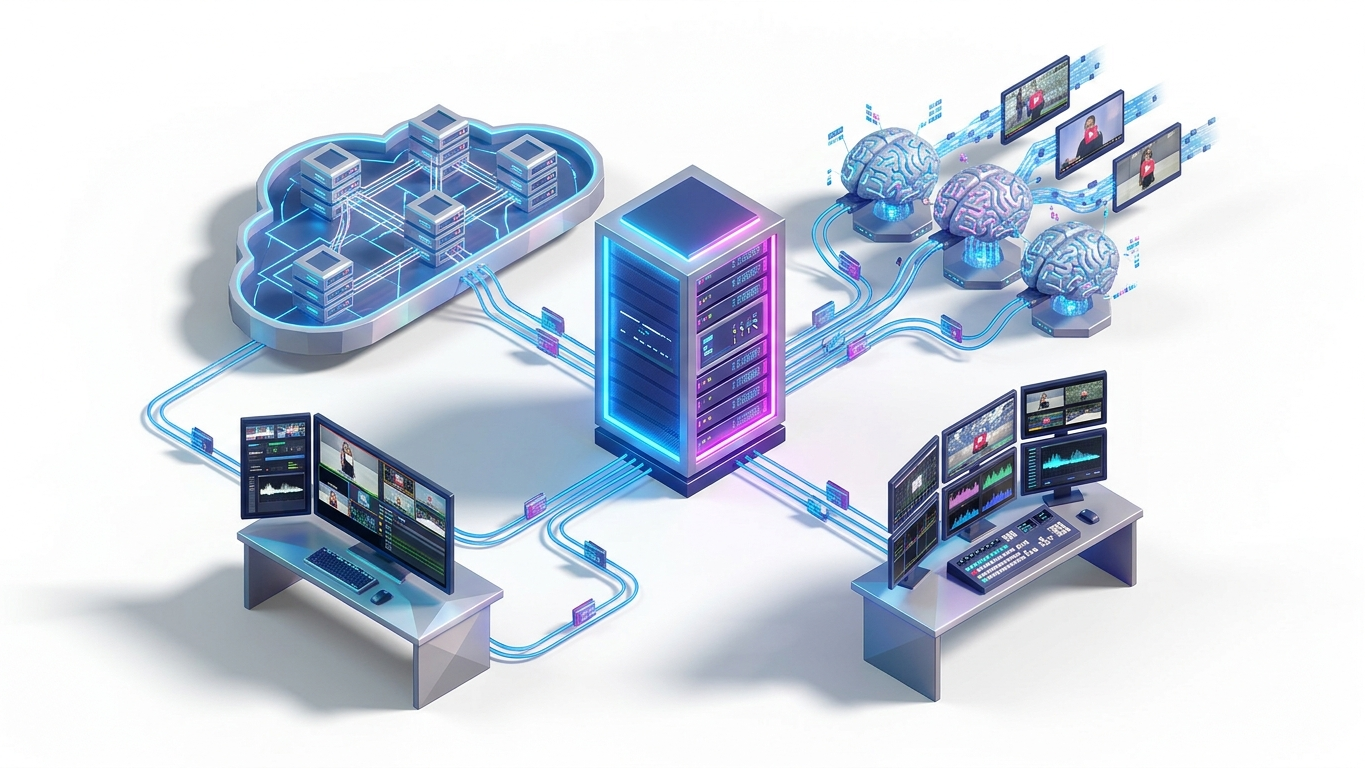
The market has forged a refined approach to infrastructure, shifting from a strictly “cloud-first” mindset to a “hybrid-first” model.
Mission-critical ultra-low-latency live broadcast operations remain on local hardware and edge nodes, while the cloud is leveraged for dynamic scaling, archiving, and remote collaboration. Concurrently, physical hardware is being broadly transitioned into software-defined architectures. Industry experts particularly highlighted the Grass Valley AVORA platform, the EVS XT-S solution, and the Grass Valley AMPP system.
Alexey Danilov (Stream Labs) also underscored the economic drivers behind the renewed interest in dedicated hardware: against a backdrop of rising server costs and surging data volumes, acquiring specialized hardware solutions—and even developing task-specific ASIC chips—is proving more cost-effective than running workloads on general-purpose servers.
Open Standards and End-to-End Distribution
The growing complexity of the content delivery chain (from rights holders to CDNs and consumer devices) is pushing the industry toward open standards to prevent vendor lock-in. Key focal points at IBC 2026 included:
- Next-Gen Protocols: The advancement of Media over QUIC (MoQ) protocols for ultra-low latency alongside the DMF broadcast architecture.
- Open Interoperability: The Media eXchange Layer (MXL) initiative—backed by the EBU, NABA, and the Linux Foundation—which received an IBC Innovation Award for establishing an open media exchange layer.
- Delivery Efficiency: The powerful pairing of the VVC/H.266 codec with multipath signal delivery.
Furthermore, FAST TV has definitively matured into a proven business model; Rakuten TV, for instance, demonstrated its operational framework managing over 100 FAST channels across European Connected TV (CTV) platforms.
Summarizing IBC 2026, industry experts agree: the future of media technology relies on synergy—where hardware guarantees reliability, software provides flexibility, the cloud enables scalability, and AI delivers automation.
Source: Cableman