



🎦 CIS Box Office Reaches Five-Year High
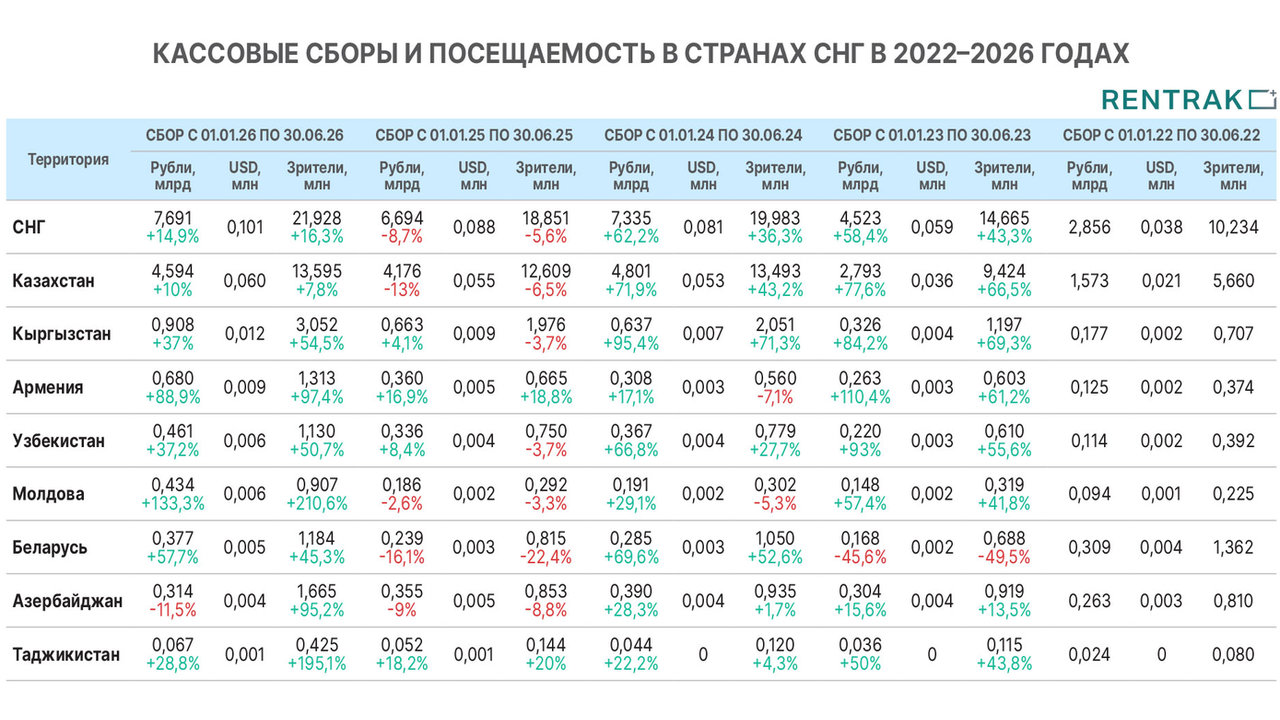
The first half of 2026 marked a period of robust recovery for the CIS film distribution market. According to Rentrak data, combined box office revenue across the region’s eight markets rose by 14.9% year-on-year, reaching 7.69 billion rubles.
Attendance trends were even more impressive: cinemas drew 21.93 million moviegoers—a 16.3% increase compared to H1 2025, setting a five-year record.
At the same time, analysts point to a deep fragmentation of cinematic models across the Commonwealth. The region no longer operates as a unified market, with growth drivers varying drastically from country to country.
Key Country Trends:
- • Kazakhstan (4.59 billion rubles, +10%): Maintains its status as the CIS’s largest market, accounting for over 60% of total regional revenue. Audience demand remains balanced: while foreign titles slightly expanded their footprint (53.2% of the box office), the top-grossing release was the Kyrgyz adventure drama Heaven Under Mothers’ Feet 2 (228.2 million rubles).
- • Kyrgyzstan (908 million rubles, +37%): Showed phenomenal growth, with domestic films generating 65.4% of total revenues (the top three spots in the charts were claimed entirely by local releases).
- • Uzbekistan (461 million rubles, +37.2%): Growth was driven by audience expansion and foreign repertoire (89.2% of total box office), with strong preferences for Hollywood franchises and Asian horror.
- • Belarus (377 million rubles, +57.7%): Recorded high growth propelled by the active return of major global premieres (the foreign film share rose to 58.6%, pushing Russian releases into second place) and the transformation of cinemas into multifunctional leisure spaces.
Russian releases have largely shifted to niche status across most CIS markets, with the exception of Belarus (where they secured a 40.1% market share). In Kazakhstan, Russian films accounted for 3.4% of the box office, 4.3% in Uzbekistan, and 1.2% in Kyrgyzstan. Family titles and strong IPs remain the flagship exports: the highest-grossing Russian film in the region was Cheburashka 2, taking 130.2 million rubles.
Industry insiders agree that future growth will depend not merely on the availability of blockbusters, but on distributors’ ability to convert casual moviegoers into regular patrons through improved service, localization, and the development of modern cinema ecosystems.
Source: Kinometro