


🧠 Orchestration Helps Studios Speed Up Pipelines Without Risking IP
The rapid evolution of artificial intelligence has made it an integral part of the visual effects (VFX) and animation industries.
Against the backdrop of growing demand for content, the primary challenge for VFX studios is no longer just adopting generative models or AI agents, but creating a secure technological environment for their deployment. This is according to Adam Cherbetji, Director of Product and AI Research at Foundry.
The main challenge lies in balancing high iteration speeds with strict security requirements. To maintain pipeline control and protect client intellectual property, experts recommend focusing on three key areas:
1. AI Orchestration and Distinguishing “Open Source” from “Open Weight”
Open models have gained immense popularity due to their accessibility; however, the VFX community must clearly distinguish between these terms. Almost all solutions labeled as “open” are actually open weight rather than open source. While they allow you to run the model, they do not provide access to the training data or code, and their commercial licenses vary significantly.
To standardize the use of such models, the Visual Effects Society has developed a five-dimensional AI taxonomy covering data, model, infrastructure, code, and usage. AI orchestration serves as the mechanism for their secure deployment—combining multiple models into repeatable workflows via an open orchestration layer where each model functions as a node.
2. Code Security and Sandboxing
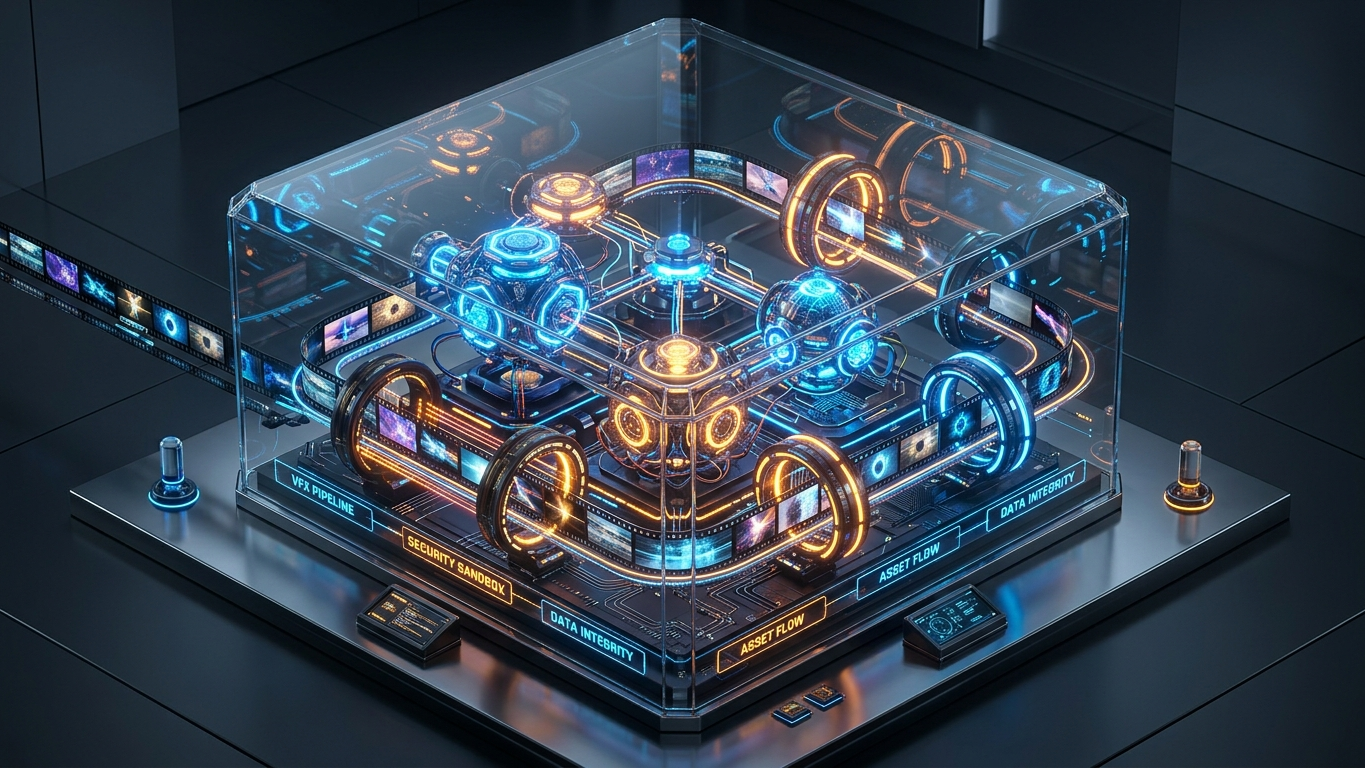
With the advent of coding agents, technical directors (TDs) and artists can quickly write custom scripts to leverage AI. However, unvetted code introduces severe vulnerabilities. Secure integration requires three essential steps:
- Isolation: Restricting file write permissions and host access so the script interacts strictly with its designated task.
- Dependency Scanning: Automatically auditing all incoming packages, nodes, and models.
- Delayed Updates: Implementing a time buffer before applying fresh releases to filter out compromised versions.
3. Asset Provenance and Commercial Licensing
Every model used in commercial production must carry an appropriate license defining its terms for local hosting and usage duration. Furthermore, studios must be able to prove the provenance of every frame. The open technical standard C2PA (Coalition for Content Provenance and Authenticity) is emerging as the industry standard for tracking revision histories and AI involvement. During early adoption, pipeline and AI data can be captured as metadata, gradually transitioning to full C2PA integration based on client requirements.
Deploying flexible orchestration frameworks (such as Foundry’s open-source framework, Griptape) automates routine workflows and relieves technical directors from manually vetting every model. This gives artists the freedom to focus on complex creative tasks while ensuring assets remain secure, compliant, and fully transparent to clients.
Source: TVB Europe