


▶️ TV by the Laws of the Internet: How and Why Broadcasters Are Launching FAST Channels
Traditional television is undergoing a fundamental transformation that can be summed up in a single sentence: media consumption is shifting to the digital space, forcing linear broadcasting to adopt the mechanics of the internet.
Audiences—particularly younger and more dynamic demographics—no longer want to be tied to cable hookups or rigid TV packages. At the same time, viewers are experiencing fatigue from endless searching and scrolling through traditional VoD catalogs, where choosing a movie or series often takes longer than watching it.
At the intersection of these two trends, the FAST (Free Ad-Supported Streaming TV) format was born and is rapidly conquering the global market—delivering free linear channels via online platforms, monetized through digital advertising.
The Global FAST Market
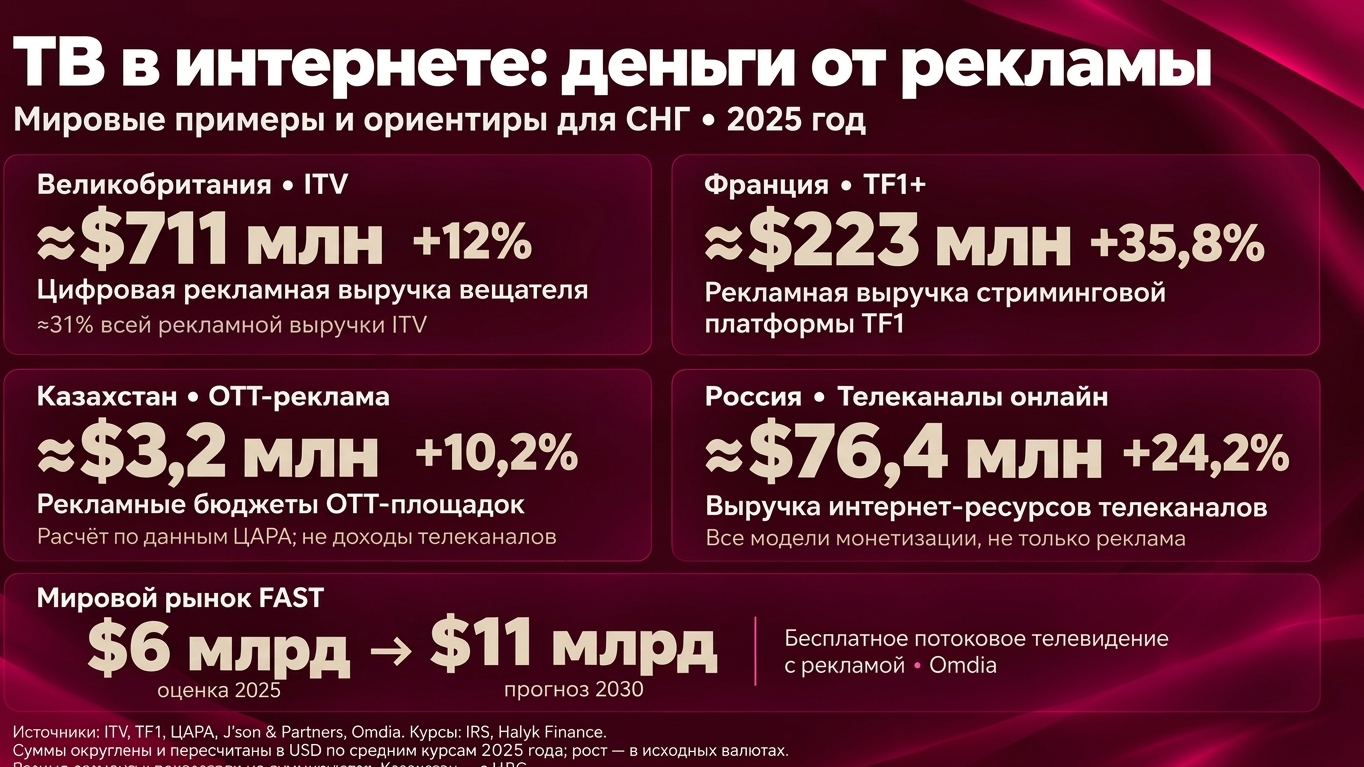
To appreciate the scale of this shift, one needs only to look at the momentum across key markets. According to Omdia data for 2025, global revenue in the FAST segment is estimated at approximately $6 billion and is projected to reach $11 billion by 2030. Unsurprisingly, the United States serves as the primary engine, generating roughly 80–81% of total global FAST revenue ($4.7–5 billion). Trailing well behind are the UK (3%), Canada (2%), Brazil (2%), Australia (2%), and Japan (2%).
However, alternative research points to even more aggressive growth: analytics firm Digital TV Research, in a forecast covering 138 countries, estimated the global FAST market had already reached $8 billion at the end of 2023 and projects it to reach $17 billion by 2029. While methodologies account for the difference in figures, the overarching trajectory is clear.
Europe is also rapidly catching up. In Spain, for instance, Omdia data puts the 2025 FAST market at $32 million, with projections to double to $65 million by 2030. Notably, 35% of adult internet users in Spain watch FAST channels monthly. By comparison, that figure stands at 26% in the UK, 25% in Germany, and 17% in France.
Content supply is expanding just as quickly. According to the updated Gracenote Data Hub (August 2026), there are now 2,172 active FAST channels tracked across 21 countries (+17.5% year-over-year), with total available FAST content exceeding 225,000 unique titles (shows, movies, series, and live sports broadcasts). To put this growth in perspective: the total channel count has nearly doubled since mid-2023, with nearly three-quarters concentrated in the US market.
Viewing Economics and Russian Market Realities
How much revenue does FAST broadcasting actually generate? Analysts at Omdia, in their Video Advertising KPI Benchmarks: Monetization study (July 2026), calculated that ad-supported CTV services have the average potential to yield $0.21 per viewer-hour (assuming 100% ad inventory sell-through). Based on this benchmark, 1 million viewer-hours can generate up to $210,000 in ad revenue. Given that the industry currently sells through only about 65% of its ad inventory, monetization potential could easily double as ad slots reach full capacity.
While analysts have yet to track FAST as a standalone segment in Russia, figures from adjacent markets clearly demonstrate the strong potential of digital TV viewing.
- Broadcasters’ Online Revenue: According to J’son & Partners Consulting, traditional broadcasters earned 6.4 billion rubles from online content distribution in 2025 (+24.2% year-over-year). This sample includes major media holdings (Gazprom-Media, CTC Media, Channel One, REN TV, among others). Furthermore, content licensing to third-party digital platforms generated an additional 20.5 billion rubles.
- The AVOD Segment: Estimates for video advertising volume vary significantly depending on methodology. TMT Consulting and TelecomDaily offer a conservative AVoD market estimate of 6.4 billion rubles. However, J’son & Partners Consulting—which factors in both in-stream and out-stream video ads before agency commissions—evaluates the Russian AVoD market at 53.2 billion rubles for 2025 (+20.2% year-over-year), representing nearly a quarter (24.2%) of Russia’s total legal video service market (220.09 billion rubles).
- CTV Advertising: According to the Visible agency, the Smart TV (Connected TV) advertising market reached 20–30 billion rubles in 2025. Growth here is being driven directly by AVoD platforms and the expansion of programmatic ad infrastructure.
It is evident that both audiences and advertising dollars have migrated to digital. However, transitioning from traditional cable and satellite to online streaming isn’t merely a change of delivery pipeline—it requires a fundamental overhaul of a broadcaster’s entire technological and business model.
Three Paths to Digital Airwaves
When planning a FAST channel launch, media companies must first evaluate their existing assets. In practice, three main scenarios have emerged for building an online linear channel:
- Leveraging an existing linear channel: The broadcaster takes an established terrestrial or thematic feed and adapts it for web delivery. The result is a dedicated OTT version where traditional ad breaks and promos are replaced with digital cues for targeted ad insertion.
- Monetizing an in-house content library: Many production houses, VoD services, and content creators hold vast libraries of rights. For them, a FAST channel is a way to revitalize back-catalog assets. Content is uploaded to a cloud system, compiled into a schedule, and delivered as a familiar linear stream that requires no decision-making from the viewer.
- Starting with a concept but no content: An investor or platform wants to launch a niche channel—such as one dedicated to mountain trekking or cooking. Content is sourced through specialized marketplaces, rights are cleared, and the acquired titles are assembled into a complete broadcast grid.
Playout Economics: The Rise of Fastplay
The single biggest barrier to the mass expansion of FAST channels is economics. A traditional niche channel with a modest, targeted audience may generate relatively small ad revenues. If a broadcaster uses traditional playout workflows—requiring continuity editors, directors, and expensive manual graphics packages—the business model immediately plunges into the red. Playout production costs quickly exceed advertising income.
The solution lies in deep automation and artificial intelligence. Under the Fastplay concept (automated playout supervised by human operators), AI handles routine tasks:
- Grid scheduling: Algorithms build optimal broadcast schedules in seconds using content metadata.
- Graphics branding and promos: Neural networks analyze audio and video tracks to build continuity graphics, “Up Next” lower thirds, and concise program synopses.
- EPG generation: Electronic Program Guides are generated and updated automatically in real time.
This approach reduces operational playout costs by approximately 75%, making super-niche, low-reach channels economically viable.
The Mechanics of Monetization and Advertising
Monetization in FAST relies on targeted digital ad insertion. For this to work seamlessly, the broadcast stream must be encoded with standardized ad markers (SCTE-35) at the origin stage to signal insertion windows and return cues.
Two main technological approaches currently coexist in the market:
- SSAI (Server-Side Ad Insertion): Ads are stitched directly into the stream on the server side. Viewers receive a single, seamless stream where transitions between program content and commercials occur without buffering or delays. The main challenge lies in the technical load required to generate a unique, personalized stream for every user.
- CSAI (Client-Side Ad Insertion): The media player on the user’s device receives a generic stream and triggers ad requests locally upon encountering an ad marker. This approach is simpler from a CDN delivery standpoint, but can introduce playback latency or volume spikes during transitions.
So what does the unit economics of a FAST channel look like? Consider a hypothetical channel with 20,000 monthly unique viewers, each averaging 5 hours of watch time (100,000 total viewer-hours). Assuming a 60% ad fill rate and a $3 CPM, total ad revenue yields roughly $2,160 per month.
From this gross figure, ad sales partners/agencies take their commission (\~20%), and the host online platform takes its revenue share (\~30%). The channel retains the remaining 50% ($1,080). After covering automated cloud playout fees ($400–$500), the broadcaster turns a net profit. Under a traditional manual playout model, this operation would run at a loss.
The Future of Broadcasting Is Digital
FAST television is not a passing trend; it is a natural evolution of media distribution. In the UK, for example, industry analysts and research agencies are already giving serious consideration to scenarios involving the total phase-out of traditional terrestrial broadcasting in favor of IP-delivered TV by the mid-2030s.
For broadcasters and rights holders across the CIS region, the takeaway is clear: building the technical foundation and reaching audiences online must happen today. The primary beneficiaries will be those who can offer compelling content in a user-friendly, free streaming format while minimizing technical overhead through automation and AI.
Author: Grigory Kuzin, Director of Media Platforms at MSK-IX