



🌐 SRT Becomes the Industry Standard for Video Transport Over the Public Internet
Analytics firm Rethink TV has released a research report on the evolution of content transport protocols over public IP networks.
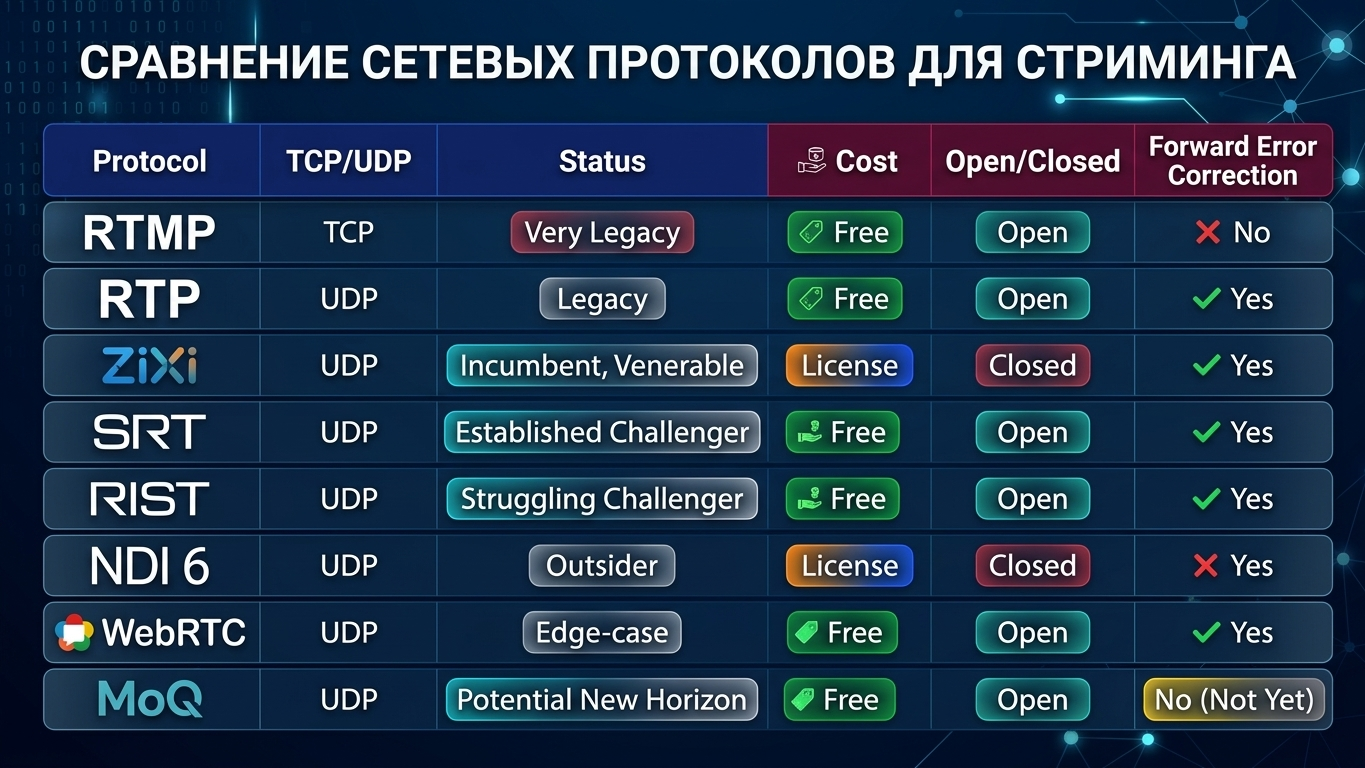
According to the experts’ findings, the Secure Reliable Transport (SRT) protocol has solidified its position as the industry standard, continuing to displace traditional satellite delivery and dedicated Direct Internet Access (DIA) fiber lines.
Growth Drivers and SRT’s Market Position
Experts point to the explosive growth of Tier-2 sports broadcasts, regional news, live concerts, and prosumer streaming as the primary catalyst for the open IP protocol market. In these deployment scenarios, the cost-to-reliability ratio plays a decisive role.
Over the past decade, SRT has evolved from a niche tool for low-latency video transmission over unmanaged networks into a universal solution. Today, it is ubiquitously deployed for primary video feed transport, integration with cloud service providers, broadcast automation systems, and intersite connectivity across distributed media venues. Analysts note that for greenfield infrastructure deployments, SRT support is assumed by default, and finding modern professional broadcast equipment without native SRT support is now virtually impossible.
Alternative Solutions and Competitive Landscape
The report offers a comprehensive assessment of other media transport protocols:
- RIST: Despite its technical sophistication, RIST remains more of an “academic initiative” for many vendors. Analysts observe that proponents of the standard often strive for perfection at the expense of practicality, whereas SRT already addresses most commercial requirements. Nevertheless, RIST is not written off entirely—it is projected to achieve moderate growth, though not market leadership.
- NDI: The adoption of NDI for video contribution and primary transport has contracted sharply. While analysts previously anticipated its expansion from creator-centric workflows into high-end broadcasting, recent price hikes and licensing policy changes have negatively impacted its uptake. NDI retains niche positions in graphics workflows and local studio environments as a simpler alternative to SMPTE ST 2110, IPMX, and SDVoE.
- Zixi: The experts distinguish between the Zixi protocol and the Zixi Software-Defined Video Platform (SDVP). Demand for the proprietary protocol is declining as customers migrate to SRT; however, the Zixi platform itself continues to monetize successfully by ingesting and processing multiprotocol traffic.
- RTP and RTMP: These protocols have definitively shifted into legacy status and persist only within legacy infrastructures where upgrades are cost-prohibitive or complex.
Future Outlook and Workflow “Softwarization”
Among potential emerging contenders, analysts highlight Media over QUIC (MoQ). Although originally designed for last-mile content distribution to end users, industry interest in leveraging MoQ for contribution workflows is growing due to its ultra-low latency built on UDP/QUIC.
An additional factor decoupling protocol selection from dedicated hardware is the ongoing trend toward the “softwarization” of broadcast workflows and AI-driven automation. For broadcasters and streaming services, the paramount value now lies in media stream interoperability and software flexibility, rather than rigid dependence on monolithic hardware or a single unified standard.
Source: TV Technology