


🏆 The 2026 FIFA World Cup Emerges as a Technological Proving Ground
The newly launched 2026 FIFA World Cup, co-hosted by Canada, Mexico, and the United States, has already made history as the largest tournament to date, featuring 48 participating nations, 16 host cities, and 104 matches.
While more than 6 million fans will attend the games in person, the primary operational burden has fallen squarely on the digital sector.
Tech analyst Paolo Pescatore notes that this World Cup has become an unprecedented proving ground, stress-testing the entire global ecosystem of broadcasting, artificial intelligence, and telecommunications.
The Media Heart of the Tournament and Hybrid Production
The International Broadcast Centre (IBC) in Dallas serves as the central nervous system of the tournament. This hub coordinates broadcast production across all stadiums continent-wide, global signal distribution, in-venue IPTV services, and metadata integration.
To navigate the colossal distances between venues, organizers have implemented a hybrid production model. While a portion of the crew operates directly on-site at the stadiums, core production workflows—such as instant replays, color correction, and video quality control—have been decentralized into centralized operational hubs. This approach significantly mitigates logistical risks, establishing a new blueprint for future global events.
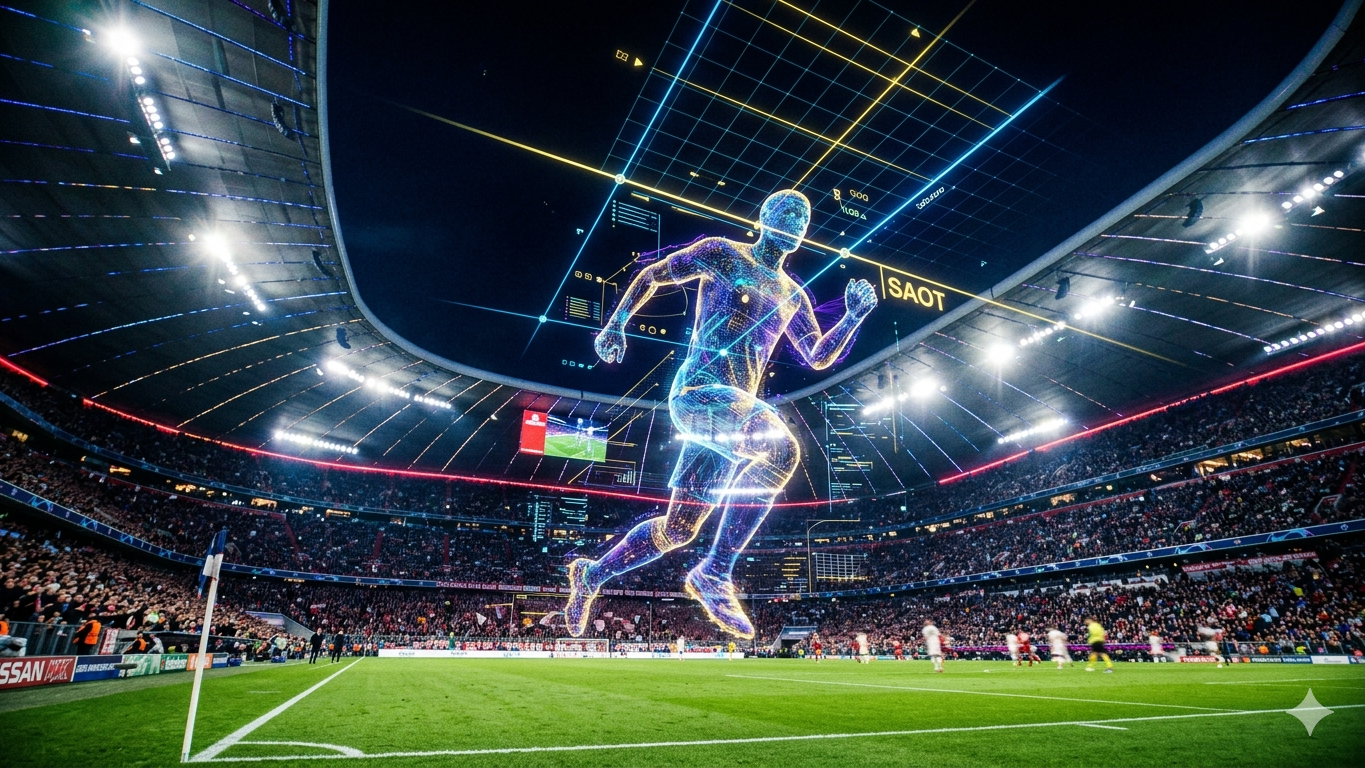
Match coverage is generated through a comprehensive arsenal of innovations, ranging from cable-cam systems and 360-degree panoramic cameras to shallow-depth-of-field cinematic cameras and RefCams (micro-cameras worn by match officials). Crucially, AI-driven image stabilization on the referee cameras allows viewers to experience the match from an immersive, on-field perspective. Furthermore, the tournament utilizes AI player avatars to power semi-automated offside technology.
A Unified AI Brain
For the first time in history, FIFA has secured a unified technology partner: Lenovo. Its engineers have deployed a massive infrastructure suite comprising over 17,000 consumer and enterprise devices, alongside advanced AI-powered platforms:
- FIFA AI Pro: A dedicated AI platform tailored for team coaches and analysts, enabling them to use natural language queries to instantly retrieve specific match clips, analyze player metrics, and make rapid tactical adjustments.
- Intelligent Command Centre: A centralized control hub that consolidates giant streams of disparate data—spanning ticketing systems, logistics, and commerce to cybersecurity, media zone workflows, and venue public safety systems.
Stadiums Powered by 5G Integration
The role of telecom operators in sporting events has expanded far beyond traditional sponsorship. Verizon has deployed a massive network infrastructure spanning all three host nations. Projections indicate that fans at any given stadium will generate upwards of 50 TB of data during a single match.
To manage peak network loads, the carrier has utilized additional 5G spectrum and installed thousands of in-stadium antennas, small cells, and mobile cell sites (COWs).
Uninterrupted connectivity for tournament officials, broadcasters, and emergency services is guaranteed through distinct enterprise solutions: dedicated Private 5G networks, fiber-optic backbones, fixed wireless access (FWA), and network slicing technology.
Ultimately, the 2026 World Cup demonstrates that modern sports are no longer just a contest between athletes on the pitch, but a battle of underlying IT platforms competing for the screens of billions of viewers worldwide.
Source: TVB Europe